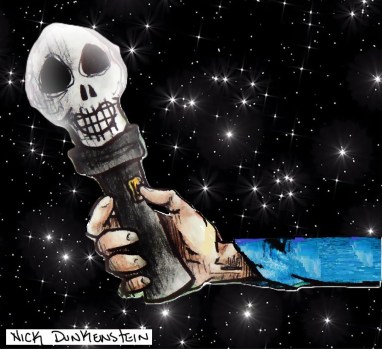
At Wormwoodiana, John Howard writes, “It was during [a] fraught period for Wells that he wrote what Adam Roberts, in H.G. Wells: A Literary Life (2019), refers to as ‘one of his oddest, most striking and most unjustly overlooked novels’ (321). This is Christina Alberta’s Father, first published one hundred years ago in September 1925.”
Tag: writing
Bill Ectric: Tales of Brave Ulysses
By Michael Limnios
First appeared on Blues.GR
December 24, 2012
Bill Ectric wants to erase the line between mysticism and science, often blending the genres of mystery, science fiction, psychological drama, humor, and metafiction. His collection, Time Adjusters and Other Stories, features the title story about an insurance company that uses new light-bending technology to capture images of future disaster areas so they can unfairly deny coverage, as well as the totally bizarre and unexplainable tale of “The House and the Baboon” and others.
Bill’s interview with jazz legend David Amram is included in the LitKicks book Beats In Time: A Literary Generation’s Legacy, edited by Levi Asher. On the internet, his writing has been featured on Literary Kicks, Candlelight Stories, The Beat, Red Fez, Empty Mirror Books, Lit Up Magazine, 99 Burning, and Zygote in My Coffee.
Bill appears as a commentator in Steve Aylett’s independent film, Lint the Movie, starring comic book writer Alan Moore.
Michael: Which historical personalities would you like to meet?
Bill: Without hesitation, my answer is Benjamin Franklin. He is possibly the coolest, most brilliant dude ever. My main interest in Franklin are his accomplishments as a writer, journalist, editor, publisher, and printer. Besides that, of course, he was a scientific researcher who invented the lightning rod, bifocals, an improved heating stove, and other things. He was a musician. He was America’s diplomat to France and one of the founders of the United States. His autobiography is free on Kindle. It’s a good read. I haven’t even named half of Franklin’s accomplishments, but of everything he did, my admiration keeps returning to his work in the media. I would like to be like Ben Franklin in the media. I don’t know what I would ask him if I could meet him. Maybe just listen to what he had to say. He was a major figure of the American Enlightenment.
I also wish I could have met William S. Burroughs.
Michael: What mistakes of the Beat generation would you want to correct?
Some of the Beats were involved in thievery and violence. We romanticized this, to some extent, the same way we romanticize pirates like Blackbeard or Captain Kidd, but if I were on a cruise ship, I wouldn’t want modern day pirates to attack us and take our money and threaten our lives. A certain amount of crime was probably inevitable, because some laws punish people for committing victimless crimes like smoking marijuana and so-called “obscenity,” so the bohemian artists and free thinkers were sharing jail cells with burglars and car thieves. Another mistake, further along during the sixties, I think the counter-culture blew their chance to keep LSD legal by scaring everybody. Instead of introducing it slowly and responsibly, they just threw it into society’s face, and encouraged anyone to try it in any environment, which naturally resulted in some bad trips.
Michael: Which motto of the Beats do you like best?
Bill: I would say, “Affirm life.” This is a condensed paraphrase of John Clellon Holmes’ article “This Is The Beat Generation,” which he wrote for the New York Times Magazine in 1952. Holmes said, in part, “Unlike the Lost Generation [after World War I], which was occupied with the loss of faith, the Beat Generation is becoming more and more occupied with the need for it . . . It is a will to believe, even in the face of an inability to do so in conventional terms.” He goes on to say, “The hot-rod driver invites death only to outwit it. He is affirming the life within him in the only way he knows how, at the extreme.” I don’t drive hot-rods and I don’t invite death. I don’t fear death but I enjoy life.
Michael: Would you mind telling me your most vivid memory from your hippie era and European trip?
Bill: The exultation of being in the classical Mediterranean world of my youthful books and dreams was incredibly heady.
One memory I have is when some friends of mine had moved into a multistory apartment building in Rota, Spain. That building and most of the surrounding buildings were radiant white in the sunshine. We were on the roof with some girls, rubbing suntan lotion on them and they on us, and we had these big Bose stereo speakers up there, cranked up really loud, with wires running from the speakers down the steps to my friends apartment. We used to drive to Morón Air Base to buy state-of-the-art audio equipment. We were listening to Live Cream, Live Cream Volume II, and Deep Purple’s Machine Head, and people on the roofs of other apartment buildings were waving to us and dancing. We were drinking rum & coke. This one Spanish girl had diet pills that were legal to buy over-the-counter, amphetamines, and someone had hashish. When Cream played Tales of Brave Ulysses and Deserted Cities of the Heart, I remembered a line from Alfred Lord Tennyson’s Ulysses about striving with gods, balanced by Percy Shelley’s warning in Ozymandias that all great things must fall, so I knew we weren’t gods but we were certainly sons of God, and it was a moment to cherish.
Another memory I have could best be expressed by quoting, if I may, a passage from my book, Tamper:
We camped out on a beach in Algeciras, Spain. Under the black, star-cluttered fabric of night, we looked out in awe at the mystical, mythical ocean, where the dark silhouette of the Rock of Gibraltar sat covered with its own stars, which were really lights from windows of houses, hotels, offices, or restaurants — distant civilization. A song by WAR called Four Cornered Room zoomed and whooshed and wailed from our battery-powered cassette tape player, blended with the wind and circled our heads with profound transcendence, while Jim passed his pipe around. Our scalps tingled as the ocean-as-biggest-thing-in-the-world swelled outside and inside us, DNA swimming through an electric womb sea.
Michael: Are there any memories from Hettie Jones, David Amram, Larry Keenan and Pete Brown, which you’d like to share with us?
Bill: Hetti Jones doesn’t live in the past. She obviously enjoys talking about experiences in Greenwich Village in the 1950s & 60s with Amiri Baraka, Allen Ginsberg, Jack Kerouac and others, but she is very involved in her present-day writing workshop at the New York State Correctional Facility for Women at Bedford Hills, helping the inmates find their voices and express themselves.
Larry Keenan was so open and generous. He asked me I would like a print of one of his photographs. Of course, I said yeah! Instead of just one print, he sent me an envelope full of prints, all signed with his initials. He gave me good advice on working with programs like Photoshop. He said, “You need to put miles on the mouse,” in other words, keep on working at it.
I interviewed David Amram by telephone. That was his idea. He thought it would be more personal than email, which it was. He expected me to record it, but I had no recording device to attach to my phone, so I just took notes furiously of everything he said. It was worth it. The cat had a lot to say and some strong opinions on the current state of the music business.
Pete Brown was, like the other three, very generous with his time. He came across as humble. On a hunch, I asked him if he ever met Alexis Korner, the seminal British blues-rock musician, whom I had met once in the 1970s, backstage after a concert in Roanoke, VA. It turned out that he had known Alexis quite well. He told me about some of the venues they shared, like The Marquee.
Michael: You had pretty interesting book: TAMPER. Where did you get that idea?
I like to think of Tamper an alchemical alloy consisting of three literary elements and a catalyst. The three elements are mystery, autobiography, and metafiction. The catalyst is Richard Shaver.
I’ve always been fascinated by unexplained mysteries: Ghostly manifestations, UFOs, and all kinds of arcane knowledge. I write this book, in part, for people who share that fascination.
When I was in Spain and Morocco, in the early 70s, no matter what was going on in the foreground of my attention, there was always a thought running through the back of my mind, “someday I will write all of this down.” Of course, not everything in Tamper happened exactly as it did in real life, but some of it is closer than you might think. For example, the “leprechaun man” Agan, whom Whit meets in Malta, is based on a person I really met in Tangier, Morocco. He really performed the threatening gesture that he does in the book. I also wanted to convey the awe and wonder of my childhood. When I was a kid, the very air seemed charged with magic. And also my darker thoughts and feelings.
Metafiction is fiction that consciously uses literary devices as part of the story, like Nabokov did in Pale Fire by including a poem “written” by one of the characters in the book, and footnotes to the poem by another character in the book. There is also a bit of historical fiction in Tamper.
The catalyst came when I read about The Shaver Mystery on web sites like Shavertron. Richard Shaver was a real-life writer of science fiction in the 1940s, for pulp magazines like Amazing Stories and Fate. To me, he was like the “Ed Wood of pulp science fiction.” Not a great writer, but very enthusiastic. He wrote about an underground race of evil creatures who surfaced at night to capture human beings and carry them down into their lairs. These creatures, called Deros, could tamper with the minds of humans by projecting weird thoughts into our heads. Shaver claimed his stories were true. At first people assumed he was just saying that for publicity, but he was very insistent that he had seen these creatures and that they were projecting terrible thoughts into his mind, which he called “tamper.” It was later discovered that Shaver had spent some time in a mental institution. When I was a kid, I sometimes heard noises late at night, and my imagination would run wild. I thought, why not take it a step further? The main character in Tamper, a boy named Whit, can relate to Richard Shaver because he is tormented by dark, indistinct murmurings. “Tamper” ties the book together. As the boy grows up, tamper can be a metaphor for teen angst. When an article about Tamper appeared on Literary Kicks, someone who had read the book posted a question to me in the comment section, asking if Whit was molested as a child, which would definitely qualify as tamper of the worst sort. I chose not to give a clear answer because I want every reader to bring his or her own meaning to the text.
Michael: What advice would you like give to Whit?
I would say, even as you take on the responsibilities of an adult, don’t lose the wonderment and magic you felt as a child. But don’t lose touch with reality. Be confident in yourself and follow your dreams.
Michael: Which is the most interesting period in your life and why?
Bill: Everything. I feel as though I live in all the times of my life. I’m in Florida, Spain, and Virginia. I’m 18 years old and I’m 58 years old. I’ve written one novel, I’ve written five novels. Well, in this present time, Tamper is my only novel but I see the others in my mind. They already exist on the timeline.
The Litkicks Interview
By Levi Asher, aka Marc Eliot Stein
This interview first appeared on the Literary Kicks website on August 24th, 2009
Levi Asher: Florida author and blogger Bill Ectric is one of my very favorites among the indie writers I’ve met here on Literary Kicks. He and I first bonded many years ago over our mutual regard for Henry David Thoreau, and he made a big showing in our 2004 collection Action Poetry: Literary Tribes for the Internet Age. His playful intellect and sweetly philosophical frame of mind make him more interesting, in my opinion, that most of the mainstream authors crowding our bookstores these days, though his work does not fit neatly into any category (is it comedy? speculative fiction? boys adventure? Nobody knows for sure).
Tamper is Bill Ectric’s most cohesive novel so far. It opens in a small town in a past golden age, as two boys take pictures in the pitch blackness of an old, abandoned church with a clunky ancient 35mm camera and ponder the mysterious orbs that bloom in the resulting photographs. What do you see when you take pictures in the dark? That’s the kind of question that absorbs the mind of a writer like Bill Ectric. Tamper evolves into a classic good-time mystery/adventure that explores the legend of Amazing Stories writer Richard Shaver, altered consciousness, and the catacombs of Malta known as the Hypogeum. I decided to ask Bill five questions about his new novel, and the results are below.
Levi: I’ve been enjoying your work for a while now, but your new novel Tamper appears to be your most ambitious and focused work to date. Can you talk about your evolution as a writer, and why you wrote this particular book at this particular time?
Bill: I’ve been writing Tamper off and on for almost three years. I started having crystal-clear dreams and visions when I stopped drinking three years ago. Looking back, it seems like I placed my writing life “on hold” upon joining the Navy in the seventies, and only picked it up again years later when I discovered Literary Kicks in the nineties. While writing Tamper, I got in touch with feelings of awe, wonder, fear, and enchantment that I hadn’t felt since childhood. More to the point is why I was able to finish writing this particular book at this particular time. I recently read The Art of the Novel by Milan Kundera, who talks about the “dazzlement” of discovering hidden truths in one’s own writing. And I read books by writers whose childhood memories seemed as magical as mine, like Swann’s Way by Proust and Dr. Sax by Kerouac. Philip K. Dick’s novel VALIS used the concept of an “influencing machine” – a term coined by psychoanalyst Viktor Tausk to describe a common trait among schizophrenics who think that some type of machine is trying to control them.
This is what many people theorize was happening to Richard Shaver, the pulp science fiction writer, who claimed that the stuff he wrote in Amazing Stories magazine was true! The question in VALIS, of course, is whether or not the main character is crazy, or is a satellite in outer space beaming signals to his brain, or is God speaking to him, or is the satellite and God one in the same? And does it make any difference?
Levi: Tamper seems to deal with the paranormal, and yet is highly grounded in real life. Do you seriously believe in supernatural influences in our life, or are you just screwing around with the theme and having fun?
Bill: I seriously believe that magic and science are both flowing wide-open at the same time, like two parallel river currents that converge briefly at points. When we really tune in to it, we see that it’s the same river, but if you look too close, it diverges again.
Science fiction writer Arthur C. Clarke said “any sufficiently advanced technology is indistinguishable from magic”. Back in the 1600s, if you said “someday men will fashion a small moon from the Earth’s metallic elements and hurl it into the heavens, giving us the power to direct thoughts from our brains to our fingertips and out to people miles away” there would have been cries of, “Witchcraft!” but I’m simply describing satellites and cell phones. Now, when I say it like that, it sounds like I’m leaning more toward science, but I should add that there have been times when my mother could sense that a family member was having some kind of problem or illness, which turned out to be true, and sometimes it was downright uncanny! Or, maybe you’ve heard about the well-documented out-of-body experience of Pam Reynolds, who nearly died in surgery in 1991. Like in many near-death experiences, she said she looked down at her own body on the operating table, surrounded by the medical team, but the fascinating part is, she described several things that she couldn’t possibly have known unless her astral experience was real.
Ever since I was a kid, I’ve read countless books on unexplained mysteries — all the supposedly documented stuff about ghosts, UFOs, the Bermuda Triangle, spontaneous human combustion, the devil’s footprints in Devon, the Bell Witch, and so on. But what a lot of people don’t get is that I am fascinated in equal measure by the stories themselves and in the mechanics of documentation. This goes to my interest in meta-fiction, which includes devices of writing as part of the story, like the poem and footnotes in Nabokov’s Pale Fire, the books within books of VanderMeer’s City of Saints and Madmen, or the complete text of Aylett’s Lint.
I sometimes find unintended humor in the way paranormal investigators use
some facts and omit others. Take the Bell Witch legend. There is a house in
Adams, Tennessee where in 1817 a man named John Bell and his family
experienced poltergeist activity. The word spread until even General Andrew
Jackson heard about it. This part is true. Jackson, his wife, and some friends
actually traveled by covered wagon to Adams, Tennessee to spend the night in the Bell house. By all accounts, nobody got much sleep that night. People were pinched and slapped in the dark, covers got pulled off of beds, weird noises were heard. Andrew Jackson is widely quoted as saying, “I would rather fight the British than to deal with the Bell Witch!” But what he actually said was, “I saw nothing, but I heard enough to convince me that I would rather fight the British than to deal with this torment they call the Bell Witch!” I tried, in Tamper, to capture some of the humorous aspect of paranormal documentation. To convey
the fun of it.
Levi: Does the fictional town of Hansburg, Virginia correspond to a real place?
Can you talk about the places in this book and what they mean to you in real life?
Bill: Oh, for sure, I based Hansburg very much on the town in Virginia where I
was born and raised, called Christiansburg. It started as a settlement called
“Hans Meadow” in the 1700s. Later, they changed the name to Christiansburg. A small, idyllic town like in the old television shows, Leave It To Beaver or Andy
Griffith or that Twilight Zone episode where Gig Young tries to revisit his
childhood. Seventy-five percent of everything in Tamper really happened, but of course, I embellished parts of it. The treasure hunt, the layout of the streets, the bag of bones, Main Street, the woods, racing sleds and bicycles downhill, are all based in reality.
Besides the events in my hometown, some of the other stuff is based on real
experience too. For example, I really did sit on a beach under the night stars in Spain, with some friends, looking out at the Rock of Gibralter, listening to Four Cornered Room by the group WAR on a small, battery operated cassette tape player, and it seemed almost transcendental at the time.
Levi: How do you plan to market and sell this novel? Do you enjoy being an
indie writer, and do you have advice for other indie writers?
Bill: I would prefer that a major publisher picked up my book and promoted it to the masses. There is one thing I like about being an indie, which is the
realization that just because a book is supposedly finished, that doesn’t mean I can’t go back and fix things. I learned by trial and error on my first two books, and I used to stress out, thinking, “What if I release a book that’s not good enough?” I either put the book out too soon and grieved over the errors, or toiled endlessly for perfection. Partly, it was not being able to afford a second edition with some of those high-priced, so-called self-publishing companies. So, I founded Surtsey Publishing, and I use CreateSpace for print-on-demand, and it’s no longer a problem. Obviously, I have to draw the line somewhere with revisions. At some point, you have to let it go. I don’t foresee any revisions on Tamper — it’s nearly perfect. But I’m going to combine the short stories from my first two books, Time Adjusters and Space Savers, into one volume, re-release them on Surtsey with some killer revisions! Anyone who has already purchased one of those books will get a chance to buy the new edition at the greatly reduced price, or maybe even get a free copy for a limited time. I haven’t worked out the details yet. But anyone interested in reading Tamper need not worry –it’s not going to change.
As for marketing, there’s been a lot of talk lately, mainly from Cory Doctorow,
about making books available online for free. Doctorow says that making his
books available free online has not hurt his book sales. I’m not quite that
adventurous yet, so I’m going to make the first three chapters of Tamper
available on the internet.
I’ve got two book signings lined up here in Jacksonville, Florida so far, where I’ll read excerpts from the book and talk about it.
I plan to use blog ads to target the various types of readers who I believe the
novel will appeal to. These include, on one hand, the pulp science fiction fans
and the Forteans, folks who know that Richard Shaver was an actual writer for
Amazing Stories Magazine in the 1940s. People who like offbeat historical
fiction. My first draft had Richard Shaver as one of the central characters, in the manner that James Morrow includes Ben Franklin as a character in his novel The Last Witchfinder, but I wasn’t sure how far I should go, so I invented Olsen Archer, a friend and colleague of Shaver, to fill out the plot.
Levi: Many blogs such as Largehearted Boy and Paper Cuts ask writers what
music they listened to while they wrote their latest books. Instead, I’d like to ask you a better question: what foods did you eat while you wrote this book?
Bill: I fell in love with olive oil and feta cheese about three years ago. I went for weeks at a time eating nothing but a big salad every day, with all kinds of fresh vegetables, topped with olive oil, vinegar, and feta cheese, and later in the evening, drinking many cups of black coffee, staying up all night. But from time to time, maybe to compensate for the lack of booze, I went on binges in which I ate big bowls of cereal with milk, bananas, raisins, peanut butter, and ice cream piled on it. I seem to be one of those all-or-nothing people. I won’t even go into the prescription drugs.
 The Astral Pages