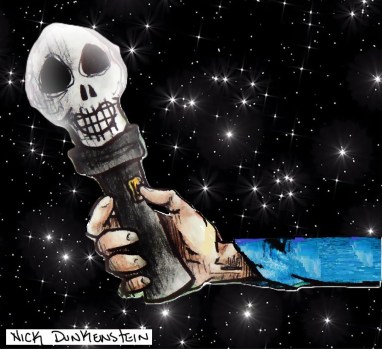
Tamper II, Chapter 3 continued…

The end of my previous posted “Chapter 3” has been modified and extended.

Wallace Breen’s aunt Rhonda swung open the front door and stood in the doorway. She was a tall biker in a black leather jacket and blue jeans, fit and slender at sixty years old. She removed her helmet with one hand, and with her other hand, pulled a hairpin from the back of her head and waved her silvery hair around once. Evie stood up at the far end of the bar and pointed one finger into the air. Rhonda saw it and walked toward us, high-fiving three bartenders on the way as one of them handed her a bottle of beer. I stood up as she approached.

“Keep your seat,” she said, and slid into the booth beside me.

“Hello, Evie,” she beamed with a winning smile.

“Hello, ma’am,” said Evie.

“Ma’am? Just call me Rhonda. Some of Wally’s friends call me Aunt Wanda.”

“Oaky, then. Well, this is Heavy Turner I told you about, and this is Whit.”

    “I know Heavy’s dad,” said Aunt Rhonda.

    “You know my dad?”

    “Well, he may not remember me. Is he still a union rep for the mechanics at the racetrack?”

“Among other things,” said Heavy.

“Wally, or Wallace as you call him, respects the union because they helped his family when his dad got laid off. That’s why he is willing to meet with your little group.”

“Where’s Wally?” asked Heavy.

“All in good time.” She held her cigarette between her thumb on one side, and three fingers along the other side, pinky out. “It’ll be worth it,” and she put the cigarette to her lips. The fire burned brightly.

Up close, Rhonda conducted herself like someone familiar with social events and mannered conversation. It was an abrupt change from her catwalk by the bar.

“Whit,” she said, “I understand you publish a newspaper dedicated to the paranormal.”

“Yes. The Astral Beat. We’re working on increasing circulation.’

“And how is that going?”

“Not well. I’m not sure whether to advertise or what.”

“I would like to discuss that with you. You know, my nephew Wally saw something that still cannot be explained. I think there is a story in it.”

“Well, look,” said Heavy. “Evie wants to get some fresh air, and you two have a lot to talk about, so we’re going out back with the band.”

“We’ll be back,” said Evie. She and Heavy went around the corner to join the band outside for a smoke.

Rhonda said, “Say, Whit, I don’t suppose you’re interested in some bennies?”

“I’m not sure.”

“You ever done bennies before?” she asked.

“No.”

She laughed and said, “Here’s one. No charge.”

I thought one pill couldn’t possibly kill me, or else they would find dead people outside of the Propeller every Sunday morning. I swallowed the pill with a gulp of beer from my Coke cup.

“Thanks.”

“Don’t mention it. As I was saying, my nephew’s story is legendary, but only locally. If we do it right, we may finally identify the axe murderer and his accomplice.”

“So you do think somebody was murdered,” I said.

“Why? Don’t you?”

“I… I believe in things that can’t be explained by science. So, yeah, I’m coming with an open mind.”

“Science can certainly explain a chopped-off head,” she said, and returned her cigarette to her mouth, under-handed, and the fire glowed like a little sunburst.

I was taken aback. Was she criticizing my approach?

“I mean the running,” I said. “The body running.”

“Yes, he saw that too,” said Rhonda. “But how can he prove it? Makes a great story either way.”  

I noticed that the nightclub had become darker, and very crowded, but my vision seemed more focused and scattered small lights connected the plasma trails of half-hidden nightlife, the dartboard, some ruckus from one of the bathrooms quickly shut down by bouncers. The pinball judder.

“Right,” I said, “Wow, this whole scene feels like synchronicity!”

“Don’t you mean déjà vu?” asked Rhonda

“No. Well, that too, maybe. But I mean synchronicity.”

“Explain?”

“In other words,” I said, “it is a meaningful coincidence. I knew Evie was a librarian, because I go to the library a lot. But I didn’t know her and rarely spoke to her. I didn’t know anything about the old Gregg house. Heavy never went to the library. But then Heavy met Evie because he came to the library with me on a whim, and he arranged to see her again, and he learned from her about the house, and you, and Wally. Wallace.”

“How intriguing,” said Rhonda.

She looked at me strangely and lit a cigarette with a Zippo lighter. Stretching around me for an ash tray near the wall, she smelled like patchouli and lighter fluid. She brushed across my chest more than I expected. Then she straightened up, gulped down the rest of her beer, and set the empty bottle on the table.

“Here’s the thing,” she said. “Wally doesn’t like to talk about what he saw that night. For one thing, it’s a terrible memory. For another thing, he’s been ridiculed in the past, so he hasn’t spoken about it for years. But he wants to tell the story. He feels more comfortable with me as a kind of agent.”

I couldn’t believe this was happening. This was good news. Did she know my paper was printed at home, on a used mimeograph machine, by a teenage high school nerd? I guzzled down the rest of my beer.

“I’m honored that you and Wallace trust me with your story,” I told her.

“I read your piece on the woman whose mother’s ghost came to her door, late at night, but the mother had died at the same time in another city!”

“Mrs. Mullins,” I said. “She had a ring of truth about her.”

I really wanted another beer. I wondered if I should ask Aunt Rhonda to get me a beer, I mean, if I gave her the money. Otherwise, I would need to find Heavy or maybe Lee the drummer. Suddenly the din of talking was overpowered by a quick clean drum roll and the band launched into Grand Funk’s Are You Ready.  

Those three ascending chords: E     F#     G!     E     F#    G!    and LOUD.

It sounded great.

I snapped out of my musical reverie at the sight of Evie and Heavy bounding in through the front door and hustling toward us through the darkened path between people at the bar and people in booths. They slid back into our booth, across from Rhonda and me, and squeezed up against each other, cuddling.

“We’re freezing to death!” said Evie.

“It’s not cold outside,” I said.

 “Been to the arctic?” asked Evie. “See any snowshoe hares?”

Evie had two empty Coke cups in her handbag, slid together, one inside the other. She separated the cups and passed one to Heavy, who held it under the table while pouring beer. He handed me the cup, with a big head of suds looking conspicuous as hell. I pressed the foam against my eyes and nose, guzzling the cold hops & barley nectar.

Wiping my face, I handed my empty cup to Heavy.

“Slow down, boy,” he said, handing a cup of beer to Rhonda. “Evie, you ready for another one? Hey, ya’ll, they have the best home-made fries here.”

I wasn’t hungry at all.

“Why was the evidence van at the scene?” I asked.

Evie and Heavy looked surprised. Heavy shook his head “no” but it was too late.

Rhonda was silent for a few seconds, all the while looking polite and reserved.

“I’m ready for a boilermaker,” she said, and reached into a pouch on her belt, producing a miniature bottle of whiskey. She unscrewed the cap and dropped the open bottle into a full cup of beer. Taking a sip, she smiled and said, “Would you like to meet Wally tonight?”

“Sure,” I said.

“He lives in the house in the woods. The one where the murder happened. Heavy, you driving?”

Tamper II, Chapter 3: The Propeller

Copyright 2026 by Bill Ectric

(still 1969)

Heavy Turner had a key that could open almost any padlock. I called it a skeleton key, but he said it was properly known as a bump key.

“On a bump key,” he said, “all the notches are cut equally deep as allowed by regulations. You insert the bump key into a padlock and tap on it with a hard object, all the pins line up and the lock pops open.” He used it to open the beer cooler behind The Propellor nightspot. We didn’t want to steal the beer, but we weren’t old enough to be served at the bar.

The Propeller was a cool nightspot, four miles outside the city limits, on the road to Radford. It catered to a combination of students from Radford College and youngish blue-collar workers, known collectively as hippies. If you were over 18, you could buy 3.2% draft beer. If you were over 21 you could buy beers with 5% alcohol or more. Heavy and I weren’t supposed to be there at all, but the owner knew Heavy’s dad.

Heavy drove Evie and I to the Propeller on a Friday night. Evie sat in front with Hev, of course, and I sat in the back. After he parked the car, Heavy turned to look back at me and said, “If anyone offers you bennies, just say I’m good, thanks.”

“I don’t think they walk right up to you,” I said.

I’m good, thanks,” he repeated.

Getting out of the car, Heavy moved fast for his bulk, rounding the car to open Evie’s door, bowing like a maître de. Evie stepped out of the car holding Heavy’s left hand. He led her out, still bowing, and released the back seat adjuster with his right hand. I pushed the passenger seat forward and climbed out of the two-door. A local band played Jimi Hendrix’s Hey Joe inside. No one else was outside to see us, so Evie went into the Propeller through the usual front door while Heavy and I darted around back to the beer cooler.

The beer cooler was like a walk-in refrigerator with a padlock on the door handle. Hev popped the lock deftly with his bump key and opened the door. Stacks of cases of cold beer greeted us. Budweiser, Carling Black Label, and Miller High Life. We each chugged a can of Carling, but Heavy finished his first and started on another one. He took a frothy gulp from the second can and set it on a convenient stack of cold boxes. He loaded the bulky pockets of his red jacket with more cans. I finally finished my beer. We re-locked the cooler and headed for the far side of the building, where metal double doors opened behind the stage, so bands could bring in drums, amps, and other equipment.

In the meantime, Evie ordered three large Cokes that came in paper cups with straws. They gave her a cardboard thing to carry the drinks. When the band finish playing “Hey Joe” Heavy opened one of the metal doors behind the band, just a crack, and whispered, “Lee…Lee.”

Lee the drummer turned around and recognized us. He smiled.

“Come on in guys.”

Anyone paying attention would have figured Heavy and I were just two more of the band’s cronies or roadies or whatever. Most of the employees couldn’t see us because the building was L shaped with the smaller section where the band played and the larger section for the bar. Both sections had booths. Heavy and I sat with Evie in a booth near the band. She had a full cup of Coke for herself and two empty Coke cups. Heavy stealthily poured two beers from his pockets into the Coke cups so we could drink beer without being noticed.

“We’re going to take a moment to tune up,” said the guitar player.

The place erupted with applause and cheers.

“The place is really hopping tonight,” said Heavy enthusiastically.

He was right. The Propeller was packed, with loud competing conversations, darts hitting a dart board, laughter. People coming and going. Cold beer. A young woman brought us a large basket of french fries. Salt and pepper shakers were on the table, and ketchup in a red squeeze bottle. Hev and Evie sat on one side of the booth and I had the other side to myself. Heavy picked up a big glistening fry, squirted a line of ketchup the entire length of it, sprinkled pep per on it and popped it into his mouth. “Nom nom, eat up.”

Wallace Breen’s aunt swung open the front door and walked in. She was a tall Biker in black leather, one who had kept in shape even as she became a grandmother at age 55. She held her helmet in one hand and high-fived the bartenders with her other hand. Evie caught her attention by waving, and I stood up as she approached.

“Keep your seat,” she said. I slid back into the booth and she sat beside me.

“Hello, Evie,” she said with a mannered smile.

“Miss…” said Evie.

“Call me Rhonda. Or Aunt Rhonda. Lots of people call me that.”

“This is Heavy Turner, who I told you about, and this is Whit King.”

“Pleased to meet you both.”

Up close, Rhonda conducted herself like someone familiar with social events and mannered conversation. It was an abrupt change from her catwalk by the bar.

“Whit,” she said, “I understand you publish a newspaper dedicated to the paranormal.”

“Yes. The Astral Pages. We’re working on increasing circulation.’

“And how is that going?”

“I don’t know. I’m not sure what to do.”

“I would like to discuss that with you. You know, my real nephew Wally Brean, saw something that still cannot be explained. I think there is a story in it. It is legendary. And if we do it right, we may finally identify the axe murderer and his accomplice.”

“That sounds good to me.”

“Say, Whit, I don’t suppose you’re interested in some bennies?”

To be continued

Home

Tamper II, Chapter 2

Tamper II: Dark Evening Wings

Chapter Two: Evie the Librarian   Copyright by Bill Ectric

Evie the librarian told Heavy Turner about the axe murder, and he told me. Evie was a recent high school graduate. She wore those Harlequin eyeglasses with little rhinestones lining the frames, and the corners pointed up like horns. She worked at the Hansbury Public Library, a two-story wood frame house, on the corner of Main and Poplar, converted into a library in 1957. The building was painted white with blue trim. It had a porch with an overhanging roof supported by two white columns. Inside, beyond the front desk and white oak card catalog were several interconnected rooms full of books on shelves. Books labeled “mature” were on the second floor, and the stairs creaked.

In 1969, Evie hung an egg-shaped wicker chair from the porch roof. She sat in the egg every day, reading magazines and books, eating apples, and drinking Fresca. Sometimes she folded her legs comfortably inside the egg; other times, she swung them out and down, primly together, until her black & white saddle shoes almost touched porch floor. People walked in and out of the library on the honor system. When somebody rang the call bell, Evie sprang nimbly from the wicker egg chair and click-clacked inside to serve the patron.

Heavy’s flat black ’67 Camaro rolled past the library, went around the block, rolled by again more slowly, turned left onto Poplar Avenue, and into the parking lot behind the library.

Heavy and I got out of the Camaro. Heavy always wore a red nylon windbreaker, which he called a racing jacket, with an STP patch over the breast. We walked around to the front and climbed the three steps up from the sidewalk onto the porch.

“Those shoes are perfect,” said Heavy.

“Beg your pardon?” she said.

“My sister had to wear those at the school she went to,” Heavy said, “and now she hates them, calls them square. But you wear them well.”

“Ironic,” she said, stretching her whole body until her feet made contact with the floor.

“After you, gentlemen,” she gestured with her hand.

Evie followed us inside.

We followed her into a back room.

Eight musty stacks of old newspapers covered most of the surface of a wooden table.

“We’re having all these microfilmed,” she said. “It’s called microfiche. Our little library is getting modern. The 1949 stack is right here.”

“You haven’t looked at it?” said Heavy.

“I’ve already seen it.”

I like the smell of old books and magazines but unfolding the aged newspapers made me sneeze.

“God bless you,” said the librarian. “Please don’t sneeze on the papers.” And then she told Heavy, “Not so rough, you’ll tear them.”

“Here it is!” said Hev.

He spread the newspaper on another table and carefully turned the pages.

Evie and I leaned in. A black & white photo of a smiling cop, made pale by the flashbulb, and a single column of newsprint. The article, “Police Find No Murder at the Gregg House,” told about a drunken homeless man who claimed to see a beheading. He had stumbled into the police station, scared out of his wits. But the policeman on the scene looked like he was enjoying himself. “Just another night on the beat,” he was quoted, joking, “I would call it the graveyard shift but we got no bodies.”

“There was nothing to it,” I said, disappointed.

“But look,” said Evie. “Look behind him.”

The corner of the house was visible in the left of the photo, lit by the residual light of the camera flash. The trees in the background were dark. Directly behind the officer we could clearly see a vehicle with a police logo. It was a black van with high walls and smooth corners, but silvery in the camera flash.

“That is a 1948 Ford Mobile Crime Lab,” said Evie. “One of the first evidence vans.”

“How do you know that?” I asked.

“I read and I listen,” she said. “But the real question is, why was forensics there if they didn’t find something?”

“Maybe they drove it, just in case,” I said.

“No,” she said. “They didn’t have an evidence van here in Hansburg. Somebody drove that thing all the way from Roanoke, fourteen miles away. Roanoke was the only city in the county that had a mobile crime unit.”

“Then the evidence van must not have found anything,” I said.

“But why were they there?” asked Heavy. “It’s like Evie says. Why were they there?”

“You know,” said Evie. “the guy who saw the murder it is still alive.”

“The drunk guy?” I asked.

“Well, he says he wasn’t that drunk, but yeah. His name is Wallace Breen. I know his aunt, sort of.”

“She told you about it?” asked Heavy.

“The beheading story is not such a big secret to the older folks in town. They just don’t care. Nobody knows for sure what really happened, and the whole thing just faded away, like everything, with time.”

“It hasn’t even been that much time,” I said.

“I told Evie about your paper,” said Heavy.

“Your newspaper sounds neat,” said Evie. “The Astral Beat? I want to read it. Would you like to meet Wallace Breen’s aunt?”

Tamper II: Dark Evening Wings

Copyright 2026 by Bill Ectric

Chapter 1: Owl, 1969

I’ll never forget the sight of that big brown owl in the black of night, perched on a limb over a dirt road, illuminated by the headlights of Heavy Turner’s flat-black ’67 Camaro. It was the night Heavy told me about the man who jumped up and ran into the woods after someone cut off his head.  

I was fifteen years old. Heavy Turner was sixteen. He showed off his driving skill and his extensive familiarity with back roads winding through the woods late at night in the foothills of the Appalachian Mountains. The dashboard lights glowed like a spaceship console. Loud swamp rock, Green River by Credence Clearwater Revival, surged from the crooked 8-track tape deck designed to fit a different dashboard. My exhilaration bordered on fright as we peeled through barely visible woods, no moon, no streetlights, and tree branches whipping against the windshield.

The road carried us up a steep hill until our headlights beamed upward onto the owl, perched on a limb, brown feathers mottled with white, yellow eyes set in great fanning discs and sternly arched forehead, watching us intrude into its dark territory.

“Did you see that?” shouted Heavy, turning down the music with his right hand.

“That was a big owl!” I said.

“It was a great horned owl, I’m pretty sure,” said Heavy, dashboard lights reflecting from his glasses when he glanced at me. “There’s one in the barn on my dad’s farm. He says it chased away the barn owls.”

The road levelled out. We drove past a row of rickety mailboxes and Hev jerked the Camaro into a hard right turn. No matter how sharp the turn, Hev’s considerable bulk kept him unmovable and unflappable in his bucket seat, while my boney frame struggled to keep from tilting and sliding with every twist of the road. I thought we were running into a ditch, but no, we were now bouncing along on a dirt road that had been virtually hidden. Hev hit the brakes and steered into a sideways skid, flinging dirt and gravel. The car stopped sideways in the road, facing an old house set back in a clearing. It was a modest, unadorned wood-frame two-story house. A wide gable served as the roof of a boxy second-floor balcony. Heavy killed his headlights, but not the engine. He was always ready for a fast getaway. The house was completely dark except for a single light shining through yellow curtains like a Van Gogh sunflower. The light in the window suddenly went dark.

“That’s the opposite of what usually happens when I drive up to a house in the middle of the night,” said Hev. “I’m surprised. I didn’t think anybody lived here. This will be a great story for your paper.”

“What’s the story?” I asked.

“Back in the 1940s, a man was beheaded in the back yard by a broad-axe.”

“No way.”

“Yeah, and it gets better,” he said. “There was a bet. A wager on whether or not a body could run after the head was cut off. Not a chicken. A human person. These two guys invited a homeless guy to this house. That night, one of the men pulled a gun on the homeless guy, took him to the back yard and forced him down, head on a tree stump.”

“No way.”

“Yeah, and one of the men said, this broad-axe might not be sharp enough to cut through your neck. I’m only going to swing this heavy ass thing one time. If it only wounds you, you’re free to run away if you can. But you better run fast, they said, or we’ll start shooting.”

“The axe was dull?”

“No! The thing was sharp as hell! They just told him it was dull to prepare him for running! They wanted to know if, when the blade hit the back of his neck, a fraction of a second before it severed his spinal cord, the last nerve impulse rushing from his brain to his body was a command to run!”  

“Did he run?”

“Hell, yes. As soon as that blade came down, his head rolled onto the ground and his body jumped over the stump and ran into the woods!”

“Who says? That can’t be.”

“They never found the head, but they found the headless body a mile away.”

“The body couldn’t have run that far,” I said. “It should have fallen down in a heap, just a little way into the woods.”

“Exactly.”

“Who are the people who supposedly saw this? Are they still alive?”

“That’s what we look into next,” said Hev. “Miss Evie has the newspaper archives and city records.”

The Camaro’s engine was still rumbling quietly.

“Why are we still sitting here?” I said, glancing around. “It’s a wonder someone hasn’t come out here with a shotgun.”

“Yeah,” said Heavy. “It’s time to go.”

He turned the wheel, hit the gas, and flicked on his headlights. Driving back over the hill, something fell with a thud onto the windshield. It was the severed head of a rabbit, oozing blood from the neck. Great wings flapped away in the dark sky.

“Ahhhh!” we both shouted.

The rabbit’s dead eyes were open, like it was looking at us through the windshield.

“Holy shit,” said Heavy. He hit the brakes on the downhill slope, so the head rolled and slid off the front of the hood. “That was freaky!”

“Did somebody throw that at us?” I asked.

“The owl dropped it. They do that sometimes.”

“Drop bloody heads on cars?!”

“Sometimes they decapitate their prey.”

“I never knew that.”

“Evie the Librarian says so. It’s a fact.”

War Over Lemuria

Book Review by Bill Ectric

Version 1.0.0

Richard Toronto is tuned in to what makes the “Shaver Mystery” so enthralling. It’s not the “mystery” itself; it’s the people behind it. What a movie War Over Lemuria would make! Imagine the figment-laced A Beautiful Mind (2001), in which Russell Crow portrayed the brilliant but schizophrenic mathematician, John Nash. Add some inner-circle editorial and publishing industry intrigue reminiscent of The Last Days of the New Yorker by Gigi Mahon or George Clooney’s biopic on Edward R. Murrow, Good Night and Good Luck. Now project this mosaic of media messaging through a prism of Ed Wood enthusiasm in the face of austerity, because this is not The New Yorker or CBS news – this is the story of a weird, almost forgotten episode in the history of pulp magazines, science fiction fans, public and private controversy, and, some would say, betrayal.

As early as 1797, when Bedlam patient James Tilly Matthews described the mental torments inflicted on him by the so-called “Air Loom,” doctors have studied victims of paranoid delusions, but post-World War II advances in science and communication galvanized the lunatic fringe with the widespread awareness of atomic energy, orbiting satellites, New Age harmonic convergence, and conspiracy theories. It was the perfect time for Shaver’s pseudoscience and Palmer’s mind-over-matter mysticism to collide.

Richard Toronto is the first to point out that Palmer embellished his life story almost compulsively; and that Shaver sometimes described things that probably weren’t there at all, even if he thought they were. All the better. What makes War Over Lemuria so fun to read are the complex personalities, the secretly interconnected publishing ventures, run-ins with the FBI, the boisterous controversy among science fiction fans, and, finally, the fact that it happened at all.

Toronto has researched the Palmer/Shaver collaboration for years. He corresponded with Richard Shaver himself, and has interviewed family members, friends, coworkers, and associates of both Shaver and Palmer. War Over Lemuria is everything I had hoped for and more.

Bill Ectric

An overlooked H. G. Wells novel

At Wormwoodiana, John Howard writes, “It was during [a] fraught period for Wells that he wrote what Adam Roberts, in H.G. Wells: A Literary Life (2019), refers to as ‘one of his oddest, most striking and most unjustly overlooked novels’ (321). This is Christina Alberta’s Father, first published one hundred years ago in September 1925.”

Read more

Bill Ectric: Tales of Brave Ulysses

By Michael Limnios

First appeared on Blues.GR

December 24, 2012

Bill Ectric wants to erase the line between mysticism and science, often blending the genres of mystery, science fiction, psychological drama, humor, and metafiction. His collection, Time Adjusters and Other Stories, features the title story about an insurance company that uses new light-bending technology to capture images of future disaster areas so they can unfairly deny coverage, as well as the totally bizarre and unexplainable tale of “The House and the Baboon” and others.

Bill’s interview with jazz legend David Amram is included in the LitKicks book Beats In Time: A Literary Generation’s Legacy, edited by Levi Asher.  On the internet, his writing has been featured on Literary Kicks, Candlelight Stories, The Beat, Red Fez, Empty Mirror Books, Lit Up Magazine, 99 Burning, and Zygote in My Coffee.

Bill appears as a commentator in Steve Aylett’s independent film, Lint the Movie, starring comic book writer Alan Moore.

Michael: Which historical personalities would you like to meet?

Bill: Without hesitation, my answer is Benjamin Franklin. He is possibly the coolest, most brilliant dude ever. My main interest in Franklin are his accomplishments as a writer, journalist, editor, publisher, and printer. Besides that, of course, he was a scientific researcher who invented the lightning rod, bifocals, an improved heating stove, and other things. He was a musician. He was America’s diplomat to France and one of the founders of the United States. His autobiography is free on Kindle. It’s a good read. I haven’t even named half of Franklin’s accomplishments, but of everything he did, my admiration keeps returning to his work in the media. I would like to be like Ben Franklin in the media. I don’t know what I would ask him if I could meet him. Maybe just listen to what he had to say. He was a major figure of the American Enlightenment.

I also wish I could have met William S. Burroughs.

Michael: What mistakes of the Beat generation would you want to correct?

Some of the Beats were involved in thievery and violence. We romanticized this, to some extent, the same way we romanticize pirates like Blackbeard or Captain Kidd, but if I were on a cruise ship, I wouldn’t want modern day pirates to attack us and take our money and threaten our lives. A certain amount of crime was probably inevitable, because some laws punish people for committing victimless crimes like smoking marijuana and so-called “obscenity,” so the bohemian artists and free thinkers were sharing jail cells with burglars and car thieves. Another mistake, further along during the sixties, I think the counter-culture blew their chance to keep LSD legal by scaring everybody. Instead of introducing it slowly and responsibly, they just threw it into society’s face, and encouraged anyone to try it in any environment, which naturally resulted in some bad trips.

Michael: Which motto of the Beats do you like best?

Bill: I would say, “Affirm life.” This is a condensed paraphrase of John Clellon Holmes’ article “This Is The Beat Generation,” which he wrote for the New York Times Magazine in 1952. Holmes said, in part, “Unlike the Lost Generation [after World War I], which was occupied with the loss of faith, the Beat Generation is becoming more and more occupied with the need for it . . . It is a will to believe, even in the face of an inability to do so in conventional terms.” He goes on to say, “The hot-rod driver invites death only to outwit it. He is affirming the life within him in the only way he knows how, at the extreme.” I don’t drive hot-rods and I don’t invite death. I don’t fear death but I enjoy life.

Michael: Would you mind telling me your most vivid memory from your hippie era and European trip?

Bill: The exultation of being in the classical Mediterranean world of my youthful books and dreams was incredibly heady.

One memory I have is when some friends of mine had moved into a multistory apartment building in Rota, Spain. That building and most of the surrounding buildings were radiant white in the sunshine. We were on the roof with some girls, rubbing suntan lotion on them and they on us, and we had these big Bose stereo speakers up there, cranked up really loud, with wires running from the speakers down the steps to my friends apartment. We used to drive to Morón Air Base to buy state-of-the-art audio equipment. We were listening to Live Cream, Live Cream Volume II, and Deep Purple’s Machine Head, and people on the roofs of other apartment buildings were waving to us and dancing. We were drinking rum & coke. This one Spanish girl had diet pills that were legal to buy over-the-counter, amphetamines, and someone had hashish. When Cream played Tales of Brave Ulysses and Deserted Cities of the Heart, I remembered a line from Alfred Lord Tennyson’s Ulysses about striving with gods, balanced by Percy Shelley’s warning in Ozymandias that all great things must fall, so I knew we weren’t gods but we were certainly sons of God, and it was a moment to cherish.

Another memory I have could best be expressed by quoting, if I may, a passage from my book, Tamper:

We camped out on a beach in Algeciras, Spain. Under the black, star-cluttered fabric of night, we looked out in awe at the mystical, mythical ocean, where the dark silhouette of the Rock of Gibraltar sat covered with its own stars, which were really lights from windows of houses, hotels, offices, or restaurants — distant civilization. A song by WAR called Four Cornered Room zoomed and whooshed and wailed from our battery-powered cassette tape player, blended with the wind and circled our heads with profound transcendence, while Jim passed his pipe around. Our scalps tingled as the ocean-as-biggest-thing-in-the-world swelled outside and inside us, DNA swimming through an electric womb sea.

Michael: Are there any memories from Hettie Jones, David Amram, Larry Keenan and Pete Brown, which you’d like to share with us?

Bill: Hetti Jones doesn’t live in the past. She obviously enjoys talking about experiences in Greenwich Village in the 1950s & 60s with Amiri Baraka, Allen Ginsberg, Jack Kerouac and others, but she is very involved in her present-day writing workshop at the New York State Correctional Facility for Women at Bedford Hills, helping the inmates find their voices and express themselves.

Larry Keenan was so open and generous. He asked me I would like a print of one of his photographs. Of course, I said yeah! Instead of just one print, he sent me an envelope full of prints, all signed with his initials. He gave me good advice on working with programs like Photoshop. He said, “You need to put miles on the mouse,” in other words, keep on working at it.

I interviewed David Amram by telephone. That was his idea. He thought it would be more personal than email, which it was. He expected me to record it, but I had no recording device to attach to my phone, so I just took notes furiously of everything he said. It was worth it. The cat had a lot to say and some strong opinions on the current state of the music business.

Pete Brown was, like the other three, very generous with his time. He came across as humble. On a hunch, I asked him if he ever met Alexis Korner, the seminal British blues-rock musician, whom I had met once in the 1970s, backstage after a concert in Roanoke, VA. It turned out that he had known Alexis quite well. He told me about some of the venues they shared, like The Marquee.

Michael: You had pretty interesting book: TAMPER. Where did you get that idea?

I like to think of Tamper an alchemical alloy consisting of three literary elements and a catalyst. The three elements are mystery, autobiography, and metafiction. The catalyst is Richard Shaver.

I’ve always been fascinated by unexplained mysteries: Ghostly manifestations, UFOs, and all kinds of arcane knowledge. I write this book, in part, for people who share that fascination.

When I was in Spain and Morocco, in the early 70s, no matter what was going on in the foreground of my attention, there was always a thought running through the back of my mind, “someday I will write all of this down.” Of course, not everything in Tamper happened exactly as it did in real life, but some of it is closer than you might think. For example, the “leprechaun man” Agan, whom Whit meets in Malta, is based on a person I really met in Tangier, Morocco. He really performed the threatening gesture that he does in the book. I also wanted to convey the awe and wonder of my childhood. When I was a kid, the very air seemed charged with magic. And also my darker thoughts and feelings.

Metafiction is fiction that consciously uses literary devices as part of the story, like Nabokov did in Pale Fire by including a poem “written” by one of the characters in the book, and footnotes to the poem by another character in the book. There is also a bit of historical fiction in Tamper.

The catalyst came when I read about The Shaver Mystery on web sites like Shavertron. Richard Shaver was a real-life writer of science fiction in the 1940s, for pulp magazines like Amazing Stories and Fate. To me, he was like the “Ed Wood of pulp science fiction.” Not a great writer, but very enthusiastic. He wrote about an underground race of evil creatures who surfaced at night to capture human beings and carry them down into their lairs. These creatures, called Deros, could tamper with the minds of humans by projecting weird thoughts into our heads. Shaver claimed his stories were true. At first people assumed he was just saying that for publicity, but he was very insistent that he had seen these creatures and that they were projecting terrible thoughts into his mind, which he called “tamper.” It was later discovered that Shaver had spent some time in a mental institution. When I was a kid, I sometimes heard noises late at night, and my imagination would run wild. I thought, why not take it a step further? The main character in Tamper, a boy named Whit, can relate to Richard Shaver because he is tormented by dark, indistinct murmurings. “Tamper” ties the book together. As the boy grows up, tamper can be a metaphor for teen angst. When an article about Tamper appeared on Literary Kicks, someone who had read the book posted a question to me in the comment section, asking if Whit was molested as a child, which would definitely qualify as tamper of the worst sort. I chose not to give a clear answer because I want every reader to bring his or her own meaning to the text.

Michael: What advice would you like give to Whit?

I would say, even as you take on the responsibilities of an adult, don’t lose the wonderment and magic you felt as a child. But don’t lose touch with reality. Be confident in yourself and follow your dreams.

Michael: Which is the most interesting period in your life and why?

Bill: Everything. I feel as though I live in all the times of my life. I’m in Florida, Spain, and Virginia. I’m 18 years old and I’m 58 years old. I’ve written one novel, I’ve written five novels. Well, in this present time, Tamper is my only novel but I see the others in my mind. They already exist on the timeline.

The Litkicks Interview

By Levi Asher, aka Marc Eliot Stein

This interview first appeared on the Literary Kicks website on August 24th, 2009

Levi Asher:
Florida author and blogger Bill Ectric is one of my very favorites among the indie writers I’ve met here on Literary Kicks. He and I first bonded many years ago over our mutual regard for Henry David Thoreau, and he made a big showing in our 2004 collection Action Poetry: Literary Tribes for the Internet Age. His playful intellect and sweetly philosophical frame of mind make him more interesting, in my opinion, that most of the mainstream authors crowding our bookstores these days, though his work does not fit neatly into any category (is it comedy? speculative fiction? boys adventure? Nobody knows for sure).

Tamper is Bill Ectric’s most cohesive novel so far. It opens in a small town in a past golden age, as two boys take pictures in the pitch blackness of an old, abandoned church with a clunky ancient 35mm camera and ponder the mysterious orbs that bloom in the resulting photographs. What do you see when you take pictures in the dark? That’s the kind of question that absorbs the mind of a writer like Bill Ectric. Tamper evolves into a classic good-time mystery/adventure that explores the legend of Amazing Stories writer Richard Shaver, altered consciousness, and the catacombs of Malta known as the Hypogeum. I decided to ask Bill five questions about his new novel, and the results are below.

Levi: I’ve been enjoying your work for a while now, but your new novel Tamper appears to be your most ambitious and focused work to date. Can you talk about your evolution as a writer, and why you wrote this particular book at this particular time?

Bill: I’ve been writing Tamper off and on for almost three years. I started having crystal-clear dreams and visions when I stopped drinking three years ago. Looking back, it seems like I placed my writing life “on hold” upon joining the Navy in the seventies, and only picked it up again years later when I discovered Literary Kicks in the nineties. While writing Tamper, I got in touch with feelings of awe, wonder, fear, and enchantment that I hadn’t felt since childhood. More to the point is why I was able to finish writing this particular book at this particular time. I recently read The Art of the Novel by Milan Kundera, who talks about the “dazzlement” of discovering hidden truths in one’s own writing. And I read books by writers whose childhood memories seemed as magical as mine, like Swann’s Way by Proust and Dr. Sax by Kerouac. Philip K. Dick’s novel VALIS used the concept of an “influencing machine” – a term coined by psychoanalyst Viktor Tausk to describe a common trait among schizophrenics who think that some type of machine is trying to control them.
This is what many people theorize was happening to Richard Shaver, the pulp science fiction writer, who claimed that the stuff he wrote in Amazing Stories magazine was true! The question in VALIS, of course, is whether or not the main character is crazy, or is a satellite in outer space beaming signals to his brain, or is God speaking to him, or is the satellite and God one in the same? And does it make any difference?

Levi: Tamper seems to deal with the paranormal, and yet is highly grounded in real life. Do you seriously believe in supernatural influences in our life, or are you just screwing around with the theme and having fun?

Bill: I seriously believe that magic and science are both flowing wide-open at the same time, like two parallel river currents that converge briefly at points. When we really tune in to it, we see that it’s the same river, but if you look too close, it diverges again.

Science fiction writer Arthur C. Clarke said “any sufficiently advanced technology is indistinguishable from magic”. Back in the 1600s, if you said “someday men will fashion a small moon from the Earth’s metallic elements and hurl it into the heavens, giving us the power to direct thoughts from our brains to our fingertips and out to people miles away” there would have been cries of, “Witchcraft!” but I’m simply describing satellites and cell phones. Now, when I say it like that, it sounds like I’m leaning more toward science, but I should add that there have been times when my mother could sense that a family member was having some kind of problem or illness, which turned out to be true, and sometimes it was downright uncanny! Or, maybe you’ve heard about the well-documented out-of-body experience of Pam Reynolds, who nearly died in surgery in 1991. Like in many near-death experiences, she said she looked down at her own body on the operating table, surrounded by the medical team, but the fascinating part is, she described several things that she couldn’t possibly have known unless her astral experience was real.

Ever since I was a kid, I’ve read countless books on unexplained mysteries — all the supposedly documented stuff about ghosts, UFOs, the Bermuda Triangle, spontaneous human combustion, the devil’s footprints in Devon, the Bell Witch, and so on. But what a lot of people don’t get is that I am fascinated in equal measure by the stories themselves and in the mechanics of documentation. This goes to my interest in meta-fiction, which includes devices of writing as part of the story, like the poem and footnotes in Nabokov’s Pale Fire, the books within books of VanderMeer’s City of Saints and Madmen, or the complete text of Aylett’s Lint.

I sometimes find unintended humor in the way paranormal investigators use
some facts and omit others. Take the Bell Witch legend. There is a house in
Adams, Tennessee where in 1817 a man named John Bell and his family
experienced poltergeist activity. The word spread until even General Andrew
Jackson heard about it. This part is true. Jackson, his wife, and some friends
actually traveled by covered wagon to Adams, Tennessee to spend the night in the Bell house. By all accounts, nobody got much sleep that night. People were pinched and slapped in the dark, covers got pulled off of beds, weird noises were heard. Andrew Jackson is widely quoted as saying, “I would rather fight the British than to deal with the Bell Witch!” But what he actually said was, “I saw nothing, but I heard enough to convince me that I would rather fight the British than to deal with this torment they call the Bell Witch!” I tried, in Tamper, to capture some of the humorous aspect of paranormal documentation. To convey
the fun of it.

Levi: Does the fictional town of Hansburg, Virginia correspond to a real place?
Can you talk about the places in this book and what they mean to you in real life?

Bill: Oh, for sure, I based Hansburg very much on the town in Virginia where I
was born and raised, called Christiansburg. It started as a settlement called
“Hans Meadow” in the 1700s. Later, they changed the name to Christiansburg. A small, idyllic town like in the old television shows, Leave It To Beaver or Andy
Griffith
 or that Twilight Zone episode where Gig Young tries to revisit his
childhood. Seventy-five percent of everything in Tamper really happened, but of course, I embellished parts of it. The treasure hunt, the layout of the streets, the bag of bones, Main Street, the woods, racing sleds and bicycles downhill, are all based in reality.

Besides the events in my hometown, some of the other stuff is based on real
experience too. For example, I really did sit on a beach under the night stars in Spain, with some friends, looking out at the Rock of Gibralter, listening to Four Cornered Room by the group WAR on a small, battery operated cassette tape player, and it seemed almost transcendental at the time.

Levi: How do you plan to market and sell this novel? Do you enjoy being an
indie writer, and do you have advice for other indie writers?

Bill: I would prefer that a major publisher picked up my book and promoted it to the masses. There is one thing I like about being an indie, which is the
realization that just because a book is supposedly finished, that doesn’t mean I can’t go back and fix things. I learned by trial and error on my first two books, and I used to stress out, thinking, “What if I release a book that’s not good enough?” I either put the book out too soon and grieved over the errors, or toiled endlessly for perfection. Partly, it was not being able to afford a second edition with some of those high-priced, so-called self-publishing companies. So, I founded Surtsey Publishing, and I use CreateSpace for print-on-demand, and it’s no longer a problem. Obviously, I have to draw the line somewhere with revisions. At some point, you have to let it go. I don’t foresee any revisions on Tamper — it’s nearly perfect. But I’m going to combine the short stories from my first two books, Time Adjusters and Space Savers, into one volume, re-release them on Surtsey with some killer revisions! Anyone who has already purchased one of those books will get a chance to buy the new edition at the greatly reduced price, or maybe even get a free copy for a limited time. I haven’t worked out the details yet. But anyone interested in reading Tamper need not worry –it’s not going to change.

As for marketing, there’s been a lot of talk lately, mainly from Cory Doctorow,
about making books available online for free. Doctorow says that making his
books available free online has not hurt his book sales. I’m not quite that
adventurous yet, so I’m going to make the first three chapters of Tamper
available on the internet.

I’ve got two book signings lined up here in Jacksonville, Florida so far, where I’ll read excerpts from the book and talk about it.

I plan to use blog ads to target the various types of readers who I believe the
novel will appeal to. These include, on one hand, the pulp science fiction fans
and the Forteans, folks who know that Richard Shaver was an actual writer for
Amazing Stories Magazine in the 1940s. People who like offbeat historical
fiction. My first draft had Richard Shaver as one of the central characters, in the manner that James Morrow includes Ben Franklin as a character in his novel The Last Witchfinder, but I wasn’t sure how far I should go, so I invented Olsen Archer, a friend and colleague of Shaver, to fill out the plot.

Levi: Many blogs such as Largehearted Boy and Paper Cuts ask writers what
music they listened to while they wrote their latest books. Instead, I’d like to ask you a better question: what foods did you eat while you wrote this book?

Bill: I fell in love with olive oil and feta cheese about three years ago. I went for weeks at a time eating nothing but a big salad every day, with all kinds of fresh vegetables, topped with olive oil, vinegar, and feta cheese, and later in the evening, drinking many cups of black coffee, staying up all night. But from time to time, maybe to compensate for the lack of booze, I went on binges in which I ate big bowls of cereal with milk, bananas, raisins, peanut butter, and ice cream piled on it. I seem to be one of those all-or-nothing people. I won’t even go into the prescription drugs.