Tamper II, Chapter 3: The Propeller

Copyright 2026 by Bill Ectric

(still 1969)

Heavy Turner had a key that could open almost any padlock. I called it a skeleton key, but he said it was properly known as a bump key.

“On a bump key,” he said, “all the notches are cut equally deep as allowed by regulations. You insert the bump key into a padlock and tap on it with a hard object, all the pins line up and the lock pops open.” He used it to open the beer cooler behind The Propellor nightspot. We didn’t want to steal the beer, but we weren’t old enough to be served at the bar.

The Propeller was a cool nightspot, four miles outside the city limits, on the road to Radford. It catered to a combination of students from Radford College and youngish blue-collar workers, known collectively as hippies. If you were over 18, you could buy 3.2% draft beer. If you were over 21 you could buy beers with 5% alcohol or more. Heavy and I weren’t supposed to be there at all, but the owner knew Heavy’s dad.

Heavy drove Evie and I to the Propeller on a Friday night. Evie sat in front with Hev, of course, and I sat in the back. After he parked the car, Heavy turned to look back at me and said, “If anyone offers you bennies, just say I’m good, thanks.”

“I don’t think they walk right up to you,” I said.

I’m good, thanks,” he repeated.

Getting out of the car, Heavy moved fast for his bulk, rounding the car to open Evie’s door, bowing like a maître de. Evie stepped out of the car holding Heavy’s left hand. He led her out, still bowing, and released the back seat adjuster with his right hand. I pushed the passenger seat forward and climbed out of the two-door. A local band played Jimi Hendrix’s Hey Joe inside. No one else was outside to see us, so Evie went into the Propeller through the usual front door while Heavy and I darted around back to the beer cooler.

The beer cooler was like a walk-in refrigerator with a padlock on the door handle. Hev popped the lock deftly with his bump key and opened the door. Stacks of cases of cold beer greeted us. Budweiser, Carling Black Label, and Miller High Life. We each chugged a can of Carling, but Heavy finished his first and started on another one. He took a frothy gulp from the second can and set it on a convenient stack of cold boxes. He loaded the bulky pockets of his red jacket with more cans. I finally finished my beer. We re-locked the cooler and headed for the far side of the building, where metal double doors opened behind the stage, so bands could bring in drums, amps, and other equipment.

In the meantime, Evie ordered three large Cokes that came in paper cups with straws. They gave her a cardboard thing to carry the drinks. When the band finish playing “Hey Joe” Heavy opened one of the metal doors behind the band, just a crack, and whispered, “Lee…Lee.”

Lee the drummer turned around and recognized us. He smiled.

“Come on in guys.”

Anyone paying attention would have figured Heavy and I were just two more of the band’s cronies or roadies or whatever. Most of the employees couldn’t see us because the building was L shaped with the smaller section where the band played and the larger section for the bar. Both sections had booths. Heavy and I sat with Evie in a booth near the band. She had a full cup of Coke for herself and two empty Coke cups. Heavy stealthily poured two beers from his pockets into the Coke cups so we could drink beer without being noticed.

“We’re going to take a moment to tune up,” said the guitar player.

The place erupted with applause and cheers.

“The place is really hopping tonight,” said Heavy enthusiastically.

He was right. The Propeller was packed, with loud competing conversations, darts hitting a dart board, laughter. People coming and going. Cold beer. A young woman brought us a large basket of french fries. Salt and pepper shakers were on the table, and ketchup in a red squeeze bottle. Hev and Evie sat on one side of the booth and I had the other side to myself. Heavy picked up a big glistening fry, squirted a line of ketchup the entire length of it, sprinkled pep per on it and popped it into his mouth. “Nom nom, eat up.”

Wallace Breen’s aunt swung open the front door and walked in. She was a tall Biker in black leather, one who had kept in shape even as she became a grandmother at age 55. She held her helmet in one hand and high-fived the bartenders with her other hand. Evie caught her attention by waving, and I stood up as she approached.

“Keep your seat,” she said. I slid back into the booth and she sat beside me.

“Hello, Evie,” she said with a mannered smile.

“Miss…” said Evie.

“Call me Rhonda. Or Aunt Rhonda. Lots of people call me that.”

“This is Heavy Turner, who I told you about, and this is Whit King.”

“Pleased to meet you both.”

Up close, Rhonda conducted herself like someone familiar with social events and mannered conversation. It was an abrupt change from her catwalk by the bar.

“Whit,” she said, “I understand you publish a newspaper dedicated to the paranormal.”

“Yes. The Astral Pages. We’re working on increasing circulation.’

“And how is that going?”

“I don’t know. I’m not sure what to do.”

“I would like to discuss that with you. You know, my real nephew Wally Brean, saw something that still cannot be explained. I think there is a story in it. It is legendary. And if we do it right, we may finally identify the axe murderer and his accomplice.”

“That sounds good to me.”

“Say, Whit, I don’t suppose you’re interested in some bennies?”

To be continued

Home

Tamper II, Chapter 2

Tamper II: Dark Evening Wings

Chapter Two: Evie the Librarian   Copyright by Bill Ectric

Evie the librarian told Heavy Turner about the axe murder, and he told me. Evie was a recent high school graduate. She wore those Harlequin eyeglasses with little rhinestones lining the frames, and the corners pointed up like horns. She worked at the Hansbury Public Library, a two-story wood frame house, on the corner of Main and Poplar, converted into a library in 1957. The building was painted white with blue trim. It had a porch with an overhanging roof supported by two white columns. Inside, beyond the front desk and white oak card catalog were several interconnected rooms full of books on shelves. Books labeled “mature” were on the second floor, and the stairs creaked.

In 1969, Evie hung an egg-shaped wicker chair from the porch roof. She sat in the egg every day, reading magazines and books, eating apples, and drinking Fresca. Sometimes she folded her legs comfortably inside the egg; other times, she swung them out and down, primly together, until her black & white saddle shoes almost touched porch floor. People walked in and out of the library on the honor system. When somebody rang the call bell, Evie sprang nimbly from the wicker egg chair and click-clacked inside to serve the patron.

Heavy’s flat black ’67 Camaro rolled past the library, went around the block, rolled by again more slowly, turned left onto Poplar Avenue, and into the parking lot behind the library.

Heavy and I got out of the Camaro. Heavy always wore a red nylon windbreaker, which he called a racing jacket, with an STP patch over the breast. We walked around to the front and climbed the three steps up from the sidewalk onto the porch.

“Those shoes are perfect,” said Heavy.

“Beg your pardon?” she said.

“My sister had to wear those at the school she went to,” Heavy said, “and now she hates them, calls them square. But you wear them well.”

“Ironic,” she said, stretching her whole body until her feet made contact with the floor.

“After you, gentlemen,” she gestured with her hand.

Evie followed us inside.

We followed her into a back room.

Eight musty stacks of old newspapers covered most of the surface of a wooden table.

“We’re having all these microfilmed,” she said. “It’s called microfiche. Our little library is getting modern. The 1949 stack is right here.”

“You haven’t looked at it?” said Heavy.

“I’ve already seen it.”

I like the smell of old books and magazines but unfolding the aged newspapers made me sneeze.

“God bless you,” said the librarian. “Please don’t sneeze on the papers.” And then she told Heavy, “Not so rough, you’ll tear them.”

“Here it is!” said Hev.

He spread the newspaper on another table and carefully turned the pages.

Evie and I leaned in. A black & white photo of a smiling cop, made pale by the flashbulb, and a single column of newsprint. The article, “Police Find No Murder at the Gregg House,” told about a drunken homeless man who claimed to see a beheading. He had stumbled into the police station, scared out of his wits. But the policeman on the scene looked like he was enjoying himself. “Just another night on the beat,” he was quoted, joking, “I would call it the graveyard shift but we got no bodies.”

“There was nothing to it,” I said, disappointed.

“But look,” said Evie. “Look behind him.”

The corner of the house was visible in the left of the photo, lit by the residual light of the camera flash. The trees in the background were dark. Directly behind the officer we could clearly see a vehicle with a police logo. It was a black van with high walls and smooth corners, but silvery in the camera flash.

“That is a 1948 Ford Mobile Crime Lab,” said Evie. “One of the first evidence vans.”

“How do you know that?” I asked.

“I read and I listen,” she said. “But the real question is, why was forensics there if they didn’t find something?”

“Maybe they drove it, just in case,” I said.

“No,” she said. “They didn’t have an evidence van here in Hansburg. Somebody drove that thing all the way from Roanoke, fourteen miles away. Roanoke was the only city in the county that had a mobile crime unit.”

“Then the evidence van must not have found anything,” I said.

“But why were they there?” asked Heavy. “It’s like Evie says. Why were they there?”

“You know,” said Evie. “the guy who saw the murder it is still alive.”

“The drunk guy?” I asked.

“Well, he says he wasn’t that drunk, but yeah. His name is Wallace Breen. I know his aunt, sort of.”

“She told you about it?” asked Heavy.

“The beheading story is not such a big secret to the older folks in town. They just don’t care. Nobody knows for sure what really happened, and the whole thing just faded away, like everything, with time.”

“It hasn’t even been that much time,” I said.

“I told Evie about your paper,” said Heavy.

“Your newspaper sounds neat,” said Evie. “The Astral Beat? I want to read it. Would you like to meet Wallace Breen’s aunt?”

E. F. Benson: Campery and Dark Psychology

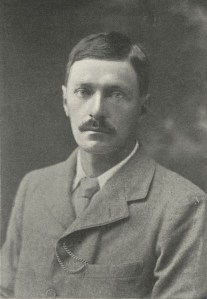
Photo from Harper’s Weekly, Public domain, via Wikimedia Commons

Over at Wormwoodiana, a guest post by John Howard begins:

“E.F. Benson (1867-1940) is probably best known today for his tales of supernatural horror and the six novels, dripping with campery and back-biting, portraying the rivalry between Elizabeth Mapp and Emmeline Lucas (‘Lucia’). Benson was a prolific and efficient writer, producing books of all kinds and qualities, including history, biography, memoir, and current affairs – as well as many other novels of social comedy and satire. A number of these blurred genre labels and could perhaps be described as explorations into dark psychology, terrible secrets, and obsession, with touches of the gothic and sensational, sometimes crossing further borders and venturing into the supernatural. Many also contained strong homosexual or homoerotic elements. Several of Benson’s novels in this vein were reprinted in paperback during the 1990s by publishers specialising in gay literature. Among them were The Inheritors (1930) and Raven’s Brood (1934); others were Colin (1923) and its continuation or sequel, Colin II – which was first published one hundred years ago in August 1925.”

Read More

Home