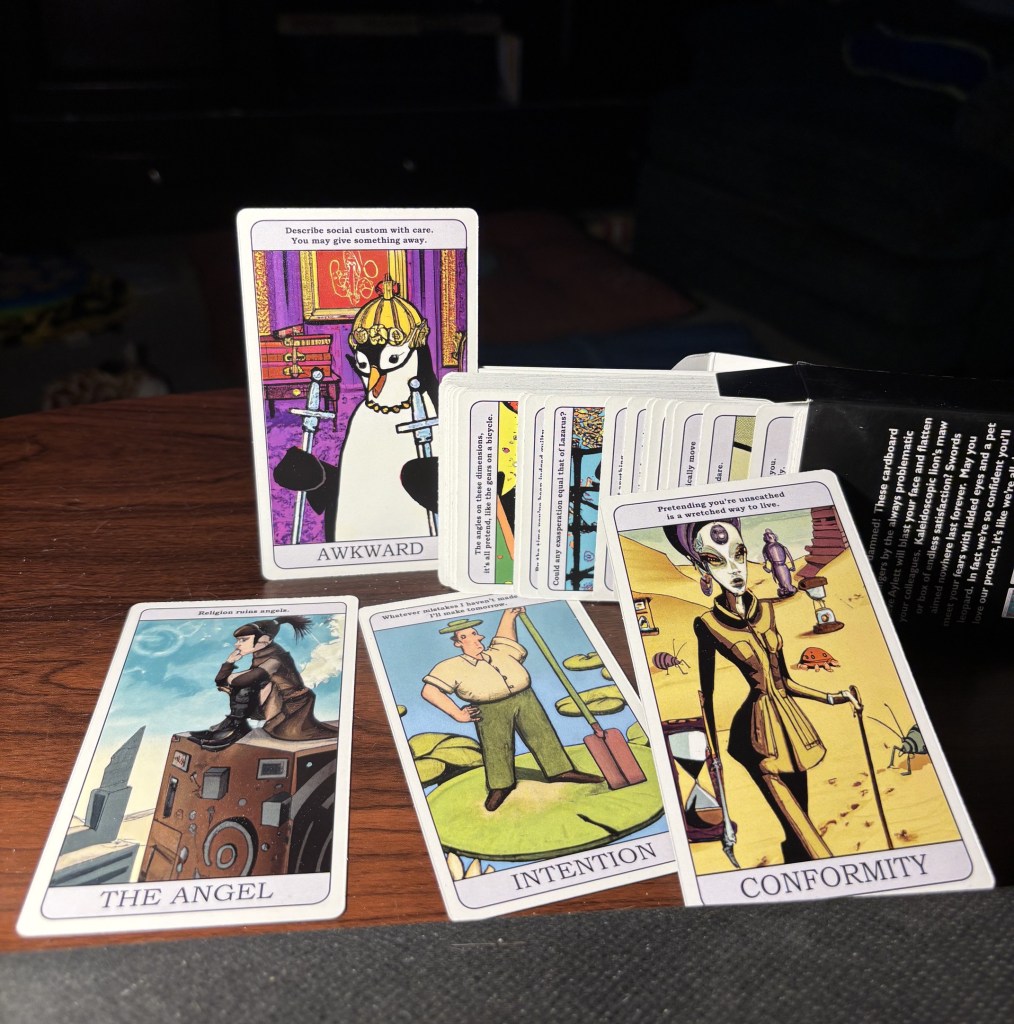
I’ve been reading these cards created by Steve Aylett.


Wallace Breen leaned back, removed the toothpick from his mouth, drank from his beer bottle, and sat there with the beer in one hand and the toothpick in the other, elbows on the armrests, and I sensed that he held the floor.
He said, “I’ll tell you what happened and I’ll tell you what didn’t happen. I was taking a shortcut through the woods that night in 1949, after leaving the VFW. I had an open bottle of Boone’s Farm Apple Wine I was drinking from. I came up behind the house, which was usually dark and deserted and I always walked on by, but that night was different. Two people in the back yard were just silhouettes in front of the bright porchlight. I didn’t even see the guy laying down at first, it was dark. I stepped closer and knelt down on one knee behind a shrub. A tall man, it seemed, had an axe handle resting on his shoulder, blade visible in profile behind him. A shorter man was leaning forward, looking down. When my eyes adjusted to the light a little more, I saw that he was pressing a rifle barrel against someone who was on his knees in front of a tree stump. The man with the rifle said you can either put your head on that stump, or I will shoot you in the back. And, the taller guy said This is a dull axe! If it doesn’t kill you, then you’re free to run! And run fast you son of a bitch or he’ll shoot you in the ass and then the head!”
“Oh, my God,” said Evie. “It’s horrible.”
“What happened?” I asked.
“Between poking the rifle against his back and kicking the dude’s feet out from under him, they forced the dude’s head down to rest on the stump, and he shouted don’t do it! Don’t! and Wait! he said. But the guy swung the axe and said run !
“I was scared. I carry the guilt. Of not helping that man, but one guy had a rifle!”
We all looked at him silently, waiting.
As though he felt the pause had lasted long enough, Wallace said, “I think what happened is, the man with the rifle got scared. He freaked out. I think he dropped his gun, jumped over the tree stump, and ran off into the woods. When the axe came down, I cringed you know, and blinked my eyes reflexively. I opened my eyes, I swear he looked like a headless silhouette, for just the brief moment, the position of the porch light, just off to one side of his head.”
“Maybe the guy on the ground jumped up,” said Heavy.
“No, he wouldn’t have had time. I’m telling you, though, that’s just the tip of the iceberg. The mystery is, what really happened, and why? Not only that, but the guy whose head was on the stump…I think he is still alive.”
“The fog is so surreal,” I said to everyone in the car, but mostly to Rhonda, who sat beside me in the dark back seat of Heavy’s car.
It was almost midnight as the flat-black ’67 Camaro carried us under and through a moving canopy of trees and fog. Evie rolled down her window because Rhonda had lit a cigarette sitting directly behind her. Rhonda gave me a funny look, holding her cigarette like a commandant.
“It doesn’t bother me,” I said.
Between the rolling fog and the occasional clearing of branches, I watched moonlight dart across Rhonda’s face. She went from old to young and back depending on how the light hit through the fog and branches. A thousand tiny wrinkles grew sharp and she looked like an old witch with one eye closed more than the other one, which frightened me. My head tingled. But then she looked classically beautiful, a shining Joan of Arc before the window. Or was it just me?
“Is this where you saw the owl?” asked Evie, in the front passenger seat.
“Wait until you see the owl in the mirror!” proclaimed Rhonda as she cracked open another miniature whiskey.
“The rear-view mirror?” asked Evie.
“No, on the dresser.”
The road carried us up a steep hill until Rhonda and I leaned back in our seats like astronauts fighting G forces. The headlights beamed upward onto an empty tree limb for a couple of seconds, then levelled out. We drove past the row of rickety mailboxes and Heavy eased the car to a stop. A light was on inside the house, on the first floor.
Heavy moved first, out the door, and around the front of the car, opening Evie’s door.
“Fat boy moves fast,” said Rhonda, cigarette in mouth, looking back at me while she exited the back seat.
I drank what remained of the whiskey in the little bottle and followed her out the door on her side of the car. She walked past Evie and Heavy and led us to the door.
The front door opened, and there stood Wallace Breen. Dark hair with gray streaks, pomaded and combed back, greaser style. Toothpick in his mouth, which he removed just long enough to say “come in” and he turned away. He wore a gray mechanic shirt, with a sewn-on name patch. When he turned away, I saw Westside Head & Block on the back.
I didn’t expect the house to look so pleasant on the inside, because the outside was so plain. It was like entering a cabin-style Air B&B. The living room had a vaulted ceiling with wooden beams and arches. To my left, I saw an entertainment center loaded with stereo components and a television. I saw a turntable, a reel-to-reel tape deck, a radio receiver/amplifier, two big speakers and two small speakers, and what was obviously his listening chair – a recliner with headphones on top of the backrest, connected by a black coiled cord plugged into the amp.
The coffee table was glossy lacquered wood with rough, uneven sides. To my right, I saw a bookshelf, couch, grandfather clock, and a door.
Wallace looked at me sullenly, removed the toothpick from his mouth, drank from a bottle of beer, turned and went to his chair and we all sat down. Rhonda acted as host, asking who wanted something to drink.
“Beer or Mountain Dew. The water from the faucet smells like rotten eggs.”
“Mountain Dew?” asked Evie.
“The pop, not the moonshine.”
“Do you live here, too?” asked Heavy.
“Nobody really lives here,” said Rhonda, pulling a cigarette from the pack with her lips. “The bedrooms are full of boxes and furniture. I own the house,” and she lit the cigarette.
“You own the Gregg house?”
“Mr. Gregg sold this house to my father in 1960. He lets us use it to hang out.”
“Incredible,” I said. “My name is Whit, by the way, and I’ve been wanting to talk to you about what you saw.”
Wallace Breen leaned forward to set his beer down on the coffee table, then leaned back and removed the toothpick from his mouth.
He said, “Hi, Whit. I appreciate your interest. I’m going to tell you one story that will disappoint you, and another story that will mystify you.”
The end of my previous posted “Chapter 3” has been modified and extended.
Wallace Breen’s aunt Rhonda swung open the front door and stood in the doorway. She was a tall biker in a black leather jacket and blue jeans, fit and slender at sixty years old. She removed her helmet with one hand, and with her other hand, pulled a hairpin from the back of her head and waved her silvery hair around once. Evie stood up at the far end of the bar and pointed one finger into the air. Rhonda saw it and walked toward us, high-fiving three bartenders on the way as one of them handed her a bottle of beer. I stood up as she approached.
“Keep your seat,” she said, and slid into the booth beside me.
“Hello, Evie,” she beamed with a winning smile.
“Hello, ma’am,” said Evie.
“Ma’am? Just call me Rhonda. Some of Wally’s friends call me Aunt Wanda.”
“Oaky, then. Well, this is Heavy Turner I told you about, and this is Whit.”
“I know Heavy’s dad,” said Aunt Rhonda.
“You know my dad?”
“Well, he may not remember me. Is he still a union rep for the mechanics at the racetrack?”
“Among other things,” said Heavy.
“Wally, or Wallace as you call him, respects the union because they helped his family when his dad got laid off. That’s why he is willing to meet with your little group.”
“Where’s Wally?” asked Heavy.
“All in good time.” She held her cigarette between her thumb on one side, and three fingers along the other side, pinky out. “It’ll be worth it,” and she put the cigarette to her lips. The fire burned brightly.
Up close, Rhonda conducted herself like someone familiar with social events and mannered conversation. It was an abrupt change from her catwalk by the bar.
“Whit,” she said, “I understand you publish a newspaper dedicated to the paranormal.”
“Yes. The Astral Beat. We’re working on increasing circulation.’
“And how is that going?”
“Not well. I’m not sure whether to advertise or what.”
“I would like to discuss that with you. You know, my nephew Wally saw something that still cannot be explained. I think there is a story in it.”
“Well, look,” said Heavy. “Evie wants to get some fresh air, and you two have a lot to talk about, so we’re going out back with the band.”
“We’ll be back,” said Evie. She and Heavy went around the corner to join the band outside for a smoke.
Rhonda said, “Say, Whit, I don’t suppose you’re interested in some bennies?”
“I’m not sure.”
“You ever done bennies before?” she asked.
“No.”
She laughed and said, “Here’s one. No charge.”
I thought one pill couldn’t possibly kill me, or else they would find dead people outside of the Propeller every Sunday morning. I swallowed the pill with a gulp of beer from my Coke cup.
“Thanks.”
“Don’t mention it. As I was saying, my nephew’s story is legendary, but only locally. If we do it right, we may finally identify the axe murderer and his accomplice.”
“So you do think somebody was murdered,” I said.
“Why? Don’t you?”
“I… I believe in things that can’t be explained by science. So, yeah, I’m coming with an open mind.”
“Science can certainly explain a chopped-off head,” she said, and returned her cigarette to her mouth, under-handed, and the fire glowed like a little sunburst.
I was taken aback. Was she criticizing my approach?
“I mean the running,” I said. “The body running.”
“Yes, he saw that too,” said Rhonda. “But how can he prove it? Makes a great story either way.”
I noticed that the nightclub had become darker, and very crowded, but my vision seemed more focused and scattered small lights connected the plasma trails of half-hidden nightlife, the dartboard, some ruckus from one of the bathrooms quickly shut down by bouncers. The pinball judder.
“Right,” I said, “Wow, this whole scene feels like synchronicity!”
“Don’t you mean déjà vu?” asked Rhonda
“No. Well, that too, maybe. But I mean synchronicity.”
“Explain?”
“In other words,” I said, “it is a meaningful coincidence. I knew Evie was a librarian, because I go to the library a lot. But I didn’t know her and rarely spoke to her. I didn’t know anything about the old Gregg house. Heavy never went to the library. But then Heavy met Evie because he came to the library with me on a whim, and he arranged to see her again, and he learned from her about the house, and you, and Wally. Wallace.”
“How intriguing,” said Rhonda.
She looked at me strangely and lit a cigarette with a Zippo lighter. Stretching around me for an ash tray near the wall, she smelled like patchouli and lighter fluid. She brushed across my chest more than I expected. Then she straightened up, gulped down the rest of her beer, and set the empty bottle on the table.
“Here’s the thing,” she said. “Wally doesn’t like to talk about what he saw that night. For one thing, it’s a terrible memory. For another thing, he’s been ridiculed in the past, so he hasn’t spoken about it for years. But he wants to tell the story. He feels more comfortable with me as a kind of agent.”
I couldn’t believe this was happening. This was good news. Did she know my paper was printed at home, on a used mimeograph machine, by a teenage high school nerd? I guzzled down the rest of my beer.
“I’m honored that you and Wallace trust me with your story,” I told her.
“I read your piece on the woman whose mother’s ghost came to her door, late at night, but the mother had died at the same time in another city!”
“Mrs. Mullins,” I said. “She had a ring of truth about her.”
I really wanted another beer. I wondered if I should ask Aunt Rhonda to get me a beer, I mean, if I gave her the money. Otherwise, I would need to find Heavy or maybe Lee the drummer. Suddenly the din of talking was overpowered by a quick clean drum roll and the band launched into Grand Funk’s Are You Ready.
Those three ascending chords: E F# G! E F# G! and LOUD.
It sounded great.
I snapped out of my musical reverie at the sight of Evie and Heavy bounding in through the front door and hustling toward us through the darkened path between people at the bar and people in booths. They slid back into our booth, across from Rhonda and me, and squeezed up against each other, cuddling.
“We’re freezing to death!” said Evie.
“It’s not cold outside,” I said.
“Been to the arctic?” asked Evie. “See any snowshoe hares?”
Evie had two empty Coke cups in her handbag, slid together, one inside the other. She separated the cups and passed one to Heavy, who held it under the table while pouring beer. He handed me the cup, with a big head of suds looking conspicuous as hell. I pressed the foam against my eyes and nose, guzzling the cold hops & barley nectar.
Wiping my face, I handed my empty cup to Heavy.
“Slow down, boy,” he said, handing a cup of beer to Rhonda. “Evie, you ready for another one? Hey, ya’ll, they have the best home-made fries here.”
I wasn’t hungry at all.
“Why was the evidence van at the scene?” I asked.
Evie and Heavy looked surprised. Heavy shook his head “no” but it was too late.
Rhonda was silent for a few seconds, all the while looking polite and reserved.
“I’m ready for a boilermaker,” she said, and reached into a pouch on her belt, producing a miniature bottle of whiskey. She unscrewed the cap and dropped the open bottle into a full cup of beer. Taking a sip, she smiled and said, “Would you like to meet Wally tonight?”
“Sure,” I said.
“He lives in the house in the woods. The one where the murder happened. Heavy, you driving?”
Copyright 2026 by Bill Ectric
(still 1969)
Heavy Turner had a key that could open almost any padlock. I called it a skeleton key, but he said it was properly known as a bump key.
“On a bump key,” he said, “all the notches are cut equally deep as allowed by regulations. You insert the bump key into a padlock and tap on it with a hard object, all the pins line up and the lock pops open.” He used it to open the beer cooler behind The Propellor nightspot. We didn’t want to steal the beer, but we weren’t old enough to be served at the bar.
The Propeller was a cool nightspot, four miles outside the city limits, on the road to Radford. It catered to a combination of students from Radford College and youngish blue-collar workers, known collectively as hippies. If you were over 18, you could buy 3.2% draft beer. If you were over 21 you could buy beers with 5% alcohol or more. Heavy and I weren’t supposed to be there at all, but the owner knew Heavy’s dad.
Heavy drove Evie and I to the Propeller on a Friday night. Evie sat in front with Hev, of course, and I sat in the back. After he parked the car, Heavy turned to look back at me and said, “If anyone offers you bennies, just say I’m good, thanks.”
“I don’t think they walk right up to you,” I said.
“I’m good, thanks,” he repeated.
Getting out of the car, Heavy moved fast for his bulk, rounding the car to open Evie’s door, bowing like a maître de. Evie stepped out of the car holding Heavy’s left hand. He led her out, still bowing, and released the back seat adjuster with his right hand. I pushed the passenger seat forward and climbed out of the two-door. A local band played Jimi Hendrix’s Hey Joe inside. No one else was outside to see us, so Evie went into the Propeller through the usual front door while Heavy and I darted around back to the beer cooler.
The beer cooler was like a walk-in refrigerator with a padlock on the door handle. Hev popped the lock deftly with his bump key and opened the door. Stacks of cases of cold beer greeted us. Budweiser, Carling Black Label, and Miller High Life. We each chugged a can of Carling, but Heavy finished his first and started on another one. He took a frothy gulp from the second can and set it on a convenient stack of cold boxes. He loaded the bulky pockets of his red jacket with more cans. I finally finished my beer. We re-locked the cooler and headed for the far side of the building, where metal double doors opened behind the stage, so bands could bring in drums, amps, and other equipment.
In the meantime, Evie ordered three large Cokes that came in paper cups with straws. They gave her a cardboard thing to carry the drinks. When the band finish playing “Hey Joe” Heavy opened one of the metal doors behind the band, just a crack, and whispered, “Lee…Lee.”
Lee the drummer turned around and recognized us. He smiled.
“Come on in guys.”
Anyone paying attention would have figured Heavy and I were just two more of the band’s cronies or roadies or whatever. Most of the employees couldn’t see us because the building was L shaped with the smaller section where the band played and the larger section for the bar. Both sections had booths. Heavy and I sat with Evie in a booth near the band. She had a full cup of Coke for herself and two empty Coke cups. Heavy stealthily poured two beers from his pockets into the Coke cups so we could drink beer without being noticed.
“We’re going to take a moment to tune up,” said the guitar player.
The place erupted with applause and cheers.
“The place is really hopping tonight,” said Heavy enthusiastically.
He was right. The Propeller was packed, with loud competing conversations, darts hitting a dart board, laughter. People coming and going. Cold beer. A young woman brought us a large basket of french fries. Salt and pepper shakers were on the table, and ketchup in a red squeeze bottle. Hev and Evie sat on one side of the booth and I had the other side to myself. Heavy picked up a big glistening fry, squirted a line of ketchup the entire length of it, sprinkled pep per on it and popped it into his mouth. “Nom nom, eat up.”
Wallace Breen’s aunt swung open the front door and walked in. She was a tall Biker in black leather, one who had kept in shape even as she became a grandmother at age 55. She held her helmet in one hand and high-fived the bartenders with her other hand. Evie caught her attention by waving, and I stood up as she approached.
“Keep your seat,” she said. I slid back into the booth and she sat beside me.
“Hello, Evie,” she said with a mannered smile.
“Miss…” said Evie.
“Call me Rhonda. Or Aunt Rhonda. Lots of people call me that.”
“This is Heavy Turner, who I told you about, and this is Whit King.”
“Pleased to meet you both.”
Up close, Rhonda conducted herself like someone familiar with social events and mannered conversation. It was an abrupt change from her catwalk by the bar.
“Whit,” she said, “I understand you publish a newspaper dedicated to the paranormal.”
“Yes. The Astral Pages. We’re working on increasing circulation.’
“And how is that going?”
“I don’t know. I’m not sure what to do.”
“I would like to discuss that with you. You know, my real nephew Wally Brean, saw something that still cannot be explained. I think there is a story in it. It is legendary. And if we do it right, we may finally identify the axe murderer and his accomplice.”
“That sounds good to me.”
“Say, Whit, I don’t suppose you’re interested in some bennies?”
To be continued
Copyright 2026 by Bill Ectric
Chapter 1: Owl, 1969
I’ll never forget the sight of that big brown owl in the black of night, perched on a limb over a dirt road, illuminated by the headlights of Heavy Turner’s flat-black ’67 Camaro. It was the night Heavy told me about the man who jumped up and ran into the woods after someone cut off his head.
I was fifteen years old. Heavy Turner was sixteen. He showed off his driving skill and his extensive familiarity with back roads winding through the woods late at night in the foothills of the Appalachian Mountains. The dashboard lights glowed like a spaceship console. Loud swamp rock, Green River by Credence Clearwater Revival, surged from the crooked 8-track tape deck designed to fit a different dashboard. My exhilaration bordered on fright as we peeled through barely visible woods, no moon, no streetlights, and tree branches whipping against the windshield.
The road carried us up a steep hill until our headlights beamed upward onto the owl, perched on a limb, brown feathers mottled with white, yellow eyes set in great fanning discs and sternly arched forehead, watching us intrude into its dark territory.
“Did you see that?” shouted Heavy, turning down the music with his right hand.
“That was a big owl!” I said.
“It was a great horned owl, I’m pretty sure,” said Heavy, dashboard lights reflecting from his glasses when he glanced at me. “There’s one in the barn on my dad’s farm. He says it chased away the barn owls.”
The road levelled out. We drove past a row of rickety mailboxes and Hev jerked the Camaro into a hard right turn. No matter how sharp the turn, Hev’s considerable bulk kept him unmovable and unflappable in his bucket seat, while my boney frame struggled to keep from tilting and sliding with every twist of the road. I thought we were running into a ditch, but no, we were now bouncing along on a dirt road that had been virtually hidden. Hev hit the brakes and steered into a sideways skid, flinging dirt and gravel. The car stopped sideways in the road, facing an old house set back in a clearing. It was a modest, unadorned wood-frame two-story house. A wide gable served as the roof of a boxy second-floor balcony. Heavy killed his headlights, but not the engine. He was always ready for a fast getaway. The house was completely dark except for a single light shining through yellow curtains like a Van Gogh sunflower. The light in the window suddenly went dark.
“That’s the opposite of what usually happens when I drive up to a house in the middle of the night,” said Hev. “I’m surprised. I didn’t think anybody lived here. This will be a great story for your paper.”
“What’s the story?” I asked.
“Back in the 1940s, a man was beheaded in the back yard by a broad-axe.”
“No way.”
“Yeah, and it gets better,” he said. “There was a bet. A wager on whether or not a body could run after the head was cut off. Not a chicken. A human person. These two guys invited a homeless guy to this house. That night, one of the men pulled a gun on the homeless guy, took him to the back yard and forced him down, head on a tree stump.”
“No way.”
“Yeah, and one of the men said, this broad-axe might not be sharp enough to cut through your neck. I’m only going to swing this heavy ass thing one time. If it only wounds you, you’re free to run away if you can. But you better run fast, they said, or we’ll start shooting.”
“The axe was dull?”
“No! The thing was sharp as hell! They just told him it was dull to prepare him for running! They wanted to know if, when the blade hit the back of his neck, a fraction of a second before it severed his spinal cord, the last nerve impulse rushing from his brain to his body was a command to run!”
“Did he run?”
“Hell, yes. As soon as that blade came down, his head rolled onto the ground and his body jumped over the stump and ran into the woods!”
“Who says? That can’t be.”
“They never found the head, but they found the headless body a mile away.”
“The body couldn’t have run that far,” I said. “It should have fallen down in a heap, just a little way into the woods.”
“Exactly.”
“Who are the people who supposedly saw this? Are they still alive?”
“That’s what we look into next,” said Hev. “Miss Evie has the newspaper archives and city records.”
The Camaro’s engine was still rumbling quietly.
“Why are we still sitting here?” I said, glancing around. “It’s a wonder someone hasn’t come out here with a shotgun.”
“Yeah,” said Heavy. “It’s time to go.”
He turned the wheel, hit the gas, and flicked on his headlights. Driving back over the hill, something fell with a thud onto the windshield. It was the severed head of a rabbit, oozing blood from the neck. Great wings flapped away in the dark sky.
“Ahhhh!” we both shouted.
The rabbit’s dead eyes were open, like it was looking at us through the windshield.
“Holy shit,” said Heavy. He hit the brakes on the downhill slope, so the head rolled and slid off the front of the hood. “That was freaky!”
“Did somebody throw that at us?” I asked.
“The owl dropped it. They do that sometimes.”
“Drop bloody heads on cars?!”
“Sometimes they decapitate their prey.”
“I never knew that.”
“Evie the Librarian says so. It’s a fact.”