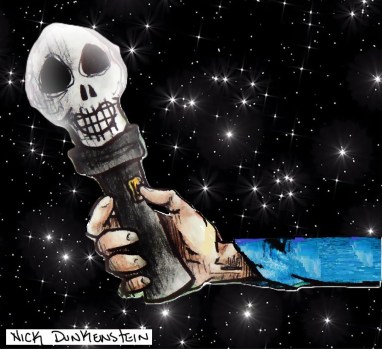
Tamper II: Dark Evening Wings
Chapter Two: Evie the Librarian Copyright by Bill Ectric
Evie the librarian told Heavy Turner about the axe murder, and he told me. Evie was a recent high school graduate. She wore those Harlequin eyeglasses with little rhinestones lining the frames, and the corners pointed up like horns. She worked at the Hansbury Public Library, a two-story wood frame house, on the corner of Main and Poplar, converted into a library in 1957. The building was painted white with blue trim. It had a porch with an overhanging roof supported by two white columns. Inside, beyond the front desk and white oak card catalog were several interconnected rooms full of books on shelves. Books labeled “mature” were on the second floor, and the stairs creaked.
In 1969, Evie hung an egg-shaped wicker chair from the porch roof. She sat in the egg every day, reading magazines and books, eating apples, and drinking Fresca. Sometimes she folded her legs comfortably inside the egg; other times, she swung them out and down, primly together, until her black & white saddle shoes almost touched porch floor. People walked in and out of the library on the honor system. When somebody rang the call bell, Evie sprang nimbly from the wicker egg chair and click-clacked inside to serve the patron.
Heavy’s flat black ’67 Camaro rolled past the library, went around the block, rolled by again more slowly, turned left onto Poplar Avenue, and into the parking lot behind the library.
Heavy and I got out of the Camaro. Heavy always wore a red nylon windbreaker, which he called a racing jacket, with an STP patch over the breast. We walked around to the front and climbed the three steps up from the sidewalk onto the porch.
“Those shoes are perfect,” said Heavy.
“Beg your pardon?” she said.
“My sister had to wear those at the school she went to,” Heavy said, “and now she hates them, calls them square. But you wear them well.”
“Ironic,” she said, stretching her whole body until her feet made contact with the floor.
“After you, gentlemen,” she gestured with her hand.
Evie followed us inside.
We followed her into a back room.
Eight musty stacks of old newspapers covered most of the surface of a wooden table.
“We’re having all these microfilmed,” she said. “It’s called microfiche. Our little library is getting modern. The 1949 stack is right here.”
I like the smell of old books and magazines but unfolding the aged newspapers made me sneeze.
“God bless you,” said the librarian. “Please don’t sneeze on the papers.” And then she told Tubby, “Not so rough, you’ll tear them.”
“Here it is!” said Tub.
He spread the newspaper on another table and carefully turned the pages.
Evie and I leaned in. A black & white photo of a smiling cop, made pale by the flashbulb, and a single column of newsprint. The article, “Police Find No Murder at the Gregg House,” told about a drunken homeless man who claimed to see a beheading. He had stumbled into the police station, scared out of his wits. But the policeman on the scene looked like he was enjoying himself. “Just another night on the beat,” he was quoted, joking, “I would call it the graveyard shift but we got no bodies.”
“There was nothing to it,” I said, disappointed.
“But look,” said Evie. “Look behind him.”
The corner of the house was visible in the left of the photo, lit by the residual light of the camera flash. The trees in the background were dark. Directly behind the officer we could clearly see a vehicle with a police logo. It was a black van with high walls and smooth corners, but silvery in the camera flash.
“That is a 1948 Ford Mobile Crime Lab,” said Evie. “One of the first evidence vans.”
“How do you know that?” I asked.
“I read all kinds of stuff,” she said. “But the real question is, why was forensics there if they didn’t find something?”
“Maybe they drove it, just in case,” I said.
“No,” she said. “They didn’t have an evidence van here in Hansburg. Somebody drove that thing all the way from Roanoke, fourteen miles away. Roanoke was the only city in the county that had a mobile crime unit.”
“Then the evidence van must not have found anything,” I said.
“But why were they there?” asked Tubb. “It’s like Evie says. Why were they there?”
“Here it is,” said Evie. She read aloud from the newspaper, “Traces of blood were analyzed and found to be not of the human type. ‘We think it was chicken blood,’ said Officer Cannaday.”
“They tested blood back then?” I asked.
They didn’t have DNA testing yet,” said Evie, “but they could detect human vs. nonhuman blood.”
“The blood wasn’t human?” said Tub, sounding hopeful. “So it could have been an inhuman monster?”
“You know,” said Evie. “the guy who saw the murder it is still alive.”
Tubby and I gave surprised looks at each other, then at her.
“The drunk guy?” asked Tub.
“Well, he says he wasn’t that drunk, but yeah.”
“You’ve got to be kidding!” I said.
“Not kidding,” she said. “His name is Wallace Breen.”
“How do you know this?” asked Tub.
“Reading and talking to people. It’s not such a big secret to the older folks in town. They just don’t care. Nobody knows what really happened and the whole thing faded away.”
“I told Evie about your paper,” said Heavy.
“Your newspaper sounds neat,” said Evie. “The Astral Beat? I want to read it.”

 The Astral Pages