War Over Lemuria

Book Review by Bill Ectric

Version 1.0.0

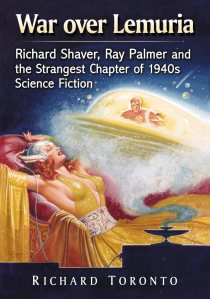
Richard Toronto is tuned in to what makes the “Shaver Mystery” so enthralling. It’s not the “mystery” itself; it’s the people behind it. What a movie War Over Lemuria would make! Imagine the figment-laced A Beautiful Mind (2001), in which Russell Crow portrayed the brilliant but schizophrenic mathematician, John Nash. Add some inner-circle editorial and publishing industry intrigue reminiscent of The Last Days of the New Yorker by Gigi Mahon or George Clooney’s biopic on Edward R. Murrow, Good Night and Good Luck. Now project this mosaic of media messaging through a prism of Ed Wood enthusiasm in the face of austerity, because this is not The New Yorker or CBS news – this is the story of a weird, almost forgotten episode in the history of pulp magazines, science fiction fans, public and private controversy, and, some would say, betrayal.

As early as 1797, when Bedlam patient James Tilly Matthews described the mental torments inflicted on him by the so-called “Air Loom,” doctors have studied victims of paranoid delusions, but post-World War II advances in science and communication galvanized the lunatic fringe with the widespread awareness of atomic energy, orbiting satellites, New Age harmonic convergence, and conspiracy theories. It was the perfect time for Shaver’s pseudoscience and Palmer’s mind-over-matter mysticism to collide.

Richard Toronto is the first to point out that Palmer embellished his life story almost compulsively; and that Shaver sometimes described things that probably weren’t there at all, even if he thought they were. All the better. What makes War Over Lemuria so fun to read are the complex personalities, the secretly interconnected publishing ventures, run-ins with the FBI, the boisterous controversy among science fiction fans, and, finally, the fact that it happened at all.

Toronto has researched the Palmer/Shaver collaboration for years. He corresponded with Richard Shaver himself, and has interviewed family members, friends, coworkers, and associates of both Shaver and Palmer. War Over Lemuria is everything I had hoped for and more.

Bill Ectric

An overlooked H. G. Wells novel

At Wormwoodiana, John Howard writes, “It was during [a] fraught period for Wells that he wrote what Adam Roberts, in H.G. Wells: A Literary Life (2019), refers to as ‘one of his oddest, most striking and most unjustly overlooked novels’ (321). This is Christina Alberta’s Father, first published one hundred years ago in September 1925.”

Read more

Dead Men Naked

Dead Men Naked is the best novel I’ve read in while, satisfying to the end. All too often, books with supernatural overtones veer into preposterous territory, but not this one. Author Dario Cannizzaro achieves a near-perfect balance of realism and phantasm, humor and melancholy, the familiar and the uncanny. It is an incredibly fun read about soul mates, tequila, occult incantations, death, and visions of a giant crow. The somewhat flippant title derives from a poem by Dylan Thomas called “And Death Shall Have No Dominion,” and, indeed, there are people in Dead Men Naked who seek passage beyond death’s veil. Cannizzaro says on his website that while writing this book, he “pestered people with talks about religion, philosophy, death for an incredible amount of time.”

To get an idea of his background, consider this quote from an article Cannizzaro wrote for The Galway Review in 2016. The author talks about skipping school with his friends at age 15 while living in in Italy:

“We would go in the city center of Pozzuoli, and hide into a dark alley. In the alley there was a tattoo joint, a hearing aid shop, and a very small library, called Il Nome della Rosa, after Umberto Eco’s book (The Name of the Rose). The owner, Gino, would entertain his guests with delicious comments about books, poetry, literature. It wasn’t long before we started spending our mornings there, talking with Gino and drinking Espresso, while watching the whirlwind of customers – lost souls on the lookout for human connection – writers, poets, mothers, sons; fishermen, shop-owners, unemployed hippies – the whole humanity passed in that library, 20 to 30 square meters of enlightened soil, much like the sacred ground of a secret church.”

Dead Men Naked reflects that mixture of ancient mystery and youthful curiosity. The main characters, Lou and Mallory, seem like people I would hang out with for pizza and beer, or in Louis’ case, Tequila. He only sees his friend’s ghost while drinking tequila. Tequila has a mystique unlike any of the other major alcoholic beverages. A Huffington Post article presented by Patrón says, “In the mid-20th century, tequila sales spiked after California residents thought it was a psychedelic. They were just confusing mezcal with mescaline (the psychoactive alkaloid of peyote” (Huffington Post, Oct 06, 2014). Over the years, Jose Quervo has placed magazine ads that depict deeply surreal colorful sunsets over small gatherings of men and women, smiling as though in states of altered consciousness, with various taglines, including “It’s all true” and “Anything can happen.” Special limited edition bottles display gold and silver mustachioed skulls. One might argue that tequila’s mystique is a fabrication, but after all, most magic is about what one believes to be true. “The universe is what you observe,” the Grim Reaper tells Lou. “Whatever you experience in your life, you experience through your senses.” It’s all real.

We get a hint that maybe Mallory has seen beyond the veil, too. She has a collection of books on the occult and she knows how to use them. Something weird happens, resulting in Mallory’s disappearance. Hoping to find Mal at her sister’s house, Lou goes on a road trip with the Grim Reaper in the passenger seat to keep him company and call the shots. They drive through a noir world of seedy bars until they find Mal’s twin sister, Angie. Death takes either a holiday or a back seat when Angie joins Lou on a ride through the desert to an out-of-the way abandoned house where the girls once lived with their mother. It is on this trip that Lou quotes the Dylan Thomas poem, forming an emotional connection between the two, in which “there was no car, no time, no road…no faith, no evil, no sun, no sea… nothing but the nakedness of the word, sliding from me to her and bouncing back from her eyes.”

At the mother’s house, in the basement, they find the books and notebooks evincing an in-depth study of dreams, mythology, religion, and “Old Latin spells mixed up with Caribbean voodoo and African juju.” It gets weirder and better.

There are so many good moments in Dead Men Naked, it’s impossible to discuss them all. Worth mentioning are the beguiling passages about crows in chapter twenty-two. Around the world, crows represent, variously, a trickster, a harbinger of death, a sign of transformation, and depending on what direction they are flying, the imminent approach of either your enemy or your true love. The crows in this chapter punctuate Lou’s action as they gather, squawk, and seemingly mock his angst with gawking, open beaks. It’s a great image and better than I can describe it.

I would like to mention one more thing. Perhaps you’ve heard about writers who don’t use quotation marks. Cormac McCarthy comes to mind. When interviewed in 2008 by Oprah Winfrey, McCarthy warns other writers that if they plan to leave out quotation marks, they really need to “write in such a way as to guide people as to who’s speaking.” I’m here to tell you that Dario Cannizzaro pulls off this feat like an expert. Trust me on this: You will have no trouble understanding who is talking to whom in Dead Men Naked.

I highly recommend this book.

E. F. Benson: Campery and Dark Psychology

Photo from Harper’s Weekly, Public domain, via Wikimedia Commons

Over at Wormwoodiana, a guest post by John Howard begins:

“E.F. Benson (1867-1940) is probably best known today for his tales of supernatural horror and the six novels, dripping with campery and back-biting, portraying the rivalry between Elizabeth Mapp and Emmeline Lucas (‘Lucia’). Benson was a prolific and efficient writer, producing books of all kinds and qualities, including history, biography, memoir, and current affairs – as well as many other novels of social comedy and satire. A number of these blurred genre labels and could perhaps be described as explorations into dark psychology, terrible secrets, and obsession, with touches of the gothic and sensational, sometimes crossing further borders and venturing into the supernatural. Many also contained strong homosexual or homoerotic elements. Several of Benson’s novels in this vein were reprinted in paperback during the 1990s by publishers specialising in gay literature. Among them were The Inheritors (1930) and Raven’s Brood (1934); others were Colin (1923) and its continuation or sequel, Colin II – which was first published one hundred years ago in August 1925.”

Read More

Home

Doyle After Death

This interview first appeared on Literary Kicks, Oct. 10, 2013

The shaded cobblestone streets of Garden Rest are lined with shops, cottages, a pub, a boarding house near the town square, and of course, something nefarious lurking in dark hinterlands. John Shirley’s Doyle After Death reads like a classic Sherlock Holmes whodunit, with a couple of major differences.

First, it takes place in the afterlife, or as the people of Garden Rest prefer to call it, the Afterworld. A private detective named Nicholas “Nick” Fogg wakes up in the Afterworld after dying in a hotel room in Las Vegas. Also, flashbacks to the detective’s last case among the living give the story a touch of gritty noir realism.

The plot advances at a breezy clip that is somehow both relaxing and exhilarating, and Shirley has a knack for cinematic descriptions. In one nighttime scene, four men look down at the town from a steep hill and see a view like a rich chiaroscuro painting. Shirley’s biographical knowledge of Arthur Conan Doyle informs the novel and confirms Shirley as a fan and a history scholar. He even includes an appendix, which expounds upon Doyle’s theories about the spirit world and incorporates those theories into the novel. Comic book collectors speak of the “Marvel universe” and the “DC universe.” This is the Doyle/Shirley universe.

Read More

Back to Ectric’s place

Bill Ectric: Tales of Brave Ulysses

By Michael Limnios

First appeared on Blues.GR

December 24, 2012

Bill Ectric wants to erase the line between mysticism and science, often blending the genres of mystery, science fiction, psychological drama, humor, and metafiction. His collection, Time Adjusters and Other Stories, features the title story about an insurance company that uses new light-bending technology to capture images of future disaster areas so they can unfairly deny coverage, as well as the totally bizarre and unexplainable tale of “The House and the Baboon” and others.

Bill’s interview with jazz legend David Amram is included in the LitKicks book Beats In Time: A Literary Generation’s Legacy, edited by Levi Asher.  On the internet, his writing has been featured on Literary Kicks, Candlelight Stories, The Beat, Red Fez, Empty Mirror Books, Lit Up Magazine, 99 Burning, and Zygote in My Coffee.

Bill appears as a commentator in Steve Aylett’s independent film, Lint the Movie, starring comic book writer Alan Moore.

Michael: Which historical personalities would you like to meet?

Bill: Without hesitation, my answer is Benjamin Franklin. He is possibly the coolest, most brilliant dude ever. My main interest in Franklin are his accomplishments as a writer, journalist, editor, publisher, and printer. Besides that, of course, he was a scientific researcher who invented the lightning rod, bifocals, an improved heating stove, and other things. He was a musician. He was America’s diplomat to France and one of the founders of the United States. His autobiography is free on Kindle. It’s a good read. I haven’t even named half of Franklin’s accomplishments, but of everything he did, my admiration keeps returning to his work in the media. I would like to be like Ben Franklin in the media. I don’t know what I would ask him if I could meet him. Maybe just listen to what he had to say. He was a major figure of the American Enlightenment.

I also wish I could have met William S. Burroughs.

Michael: What mistakes of the Beat generation would you want to correct?

Some of the Beats were involved in thievery and violence. We romanticized this, to some extent, the same way we romanticize pirates like Blackbeard or Captain Kidd, but if I were on a cruise ship, I wouldn’t want modern day pirates to attack us and take our money and threaten our lives. A certain amount of crime was probably inevitable, because some laws punish people for committing victimless crimes like smoking marijuana and so-called “obscenity,” so the bohemian artists and free thinkers were sharing jail cells with burglars and car thieves. Another mistake, further along during the sixties, I think the counter-culture blew their chance to keep LSD legal by scaring everybody. Instead of introducing it slowly and responsibly, they just threw it into society’s face, and encouraged anyone to try it in any environment, which naturally resulted in some bad trips.

Michael: Which motto of the Beats do you like best?

Bill: I would say, “Affirm life.” This is a condensed paraphrase of John Clellon Holmes’ article “This Is The Beat Generation,” which he wrote for the New York Times Magazine in 1952. Holmes said, in part, “Unlike the Lost Generation [after World War I], which was occupied with the loss of faith, the Beat Generation is becoming more and more occupied with the need for it . . . It is a will to believe, even in the face of an inability to do so in conventional terms.” He goes on to say, “The hot-rod driver invites death only to outwit it. He is affirming the life within him in the only way he knows how, at the extreme.” I don’t drive hot-rods and I don’t invite death. I don’t fear death but I enjoy life.

Michael: Would you mind telling me your most vivid memory from your hippie era and European trip?

Bill: The exultation of being in the classical Mediterranean world of my youthful books and dreams was incredibly heady.

One memory I have is when some friends of mine had moved into a multistory apartment building in Rota, Spain. That building and most of the surrounding buildings were radiant white in the sunshine. We were on the roof with some girls, rubbing suntan lotion on them and they on us, and we had these big Bose stereo speakers up there, cranked up really loud, with wires running from the speakers down the steps to my friends apartment. We used to drive to Morón Air Base to buy state-of-the-art audio equipment. We were listening to Live Cream, Live Cream Volume II, and Deep Purple’s Machine Head, and people on the roofs of other apartment buildings were waving to us and dancing. We were drinking rum & coke. This one Spanish girl had diet pills that were legal to buy over-the-counter, amphetamines, and someone had hashish. When Cream played Tales of Brave Ulysses and Deserted Cities of the Heart, I remembered a line from Alfred Lord Tennyson’s Ulysses about striving with gods, balanced by Percy Shelley’s warning in Ozymandias that all great things must fall, so I knew we weren’t gods but we were certainly sons of God, and it was a moment to cherish.

Another memory I have could best be expressed by quoting, if I may, a passage from my book, Tamper:

We camped out on a beach in Algeciras, Spain. Under the black, star-cluttered fabric of night, we looked out in awe at the mystical, mythical ocean, where the dark silhouette of the Rock of Gibraltar sat covered with its own stars, which were really lights from windows of houses, hotels, offices, or restaurants — distant civilization. A song by WAR called Four Cornered Room zoomed and whooshed and wailed from our battery-powered cassette tape player, blended with the wind and circled our heads with profound transcendence, while Jim passed his pipe around. Our scalps tingled as the ocean-as-biggest-thing-in-the-world swelled outside and inside us, DNA swimming through an electric womb sea.

Michael: Are there any memories from Hettie Jones, David Amram, Larry Keenan and Pete Brown, which you’d like to share with us?

Bill: Hetti Jones doesn’t live in the past. She obviously enjoys talking about experiences in Greenwich Village in the 1950s & 60s with Amiri Baraka, Allen Ginsberg, Jack Kerouac and others, but she is very involved in her present-day writing workshop at the New York State Correctional Facility for Women at Bedford Hills, helping the inmates find their voices and express themselves.

Larry Keenan was so open and generous. He asked me I would like a print of one of his photographs. Of course, I said yeah! Instead of just one print, he sent me an envelope full of prints, all signed with his initials. He gave me good advice on working with programs like Photoshop. He said, “You need to put miles on the mouse,” in other words, keep on working at it.

I interviewed David Amram by telephone. That was his idea. He thought it would be more personal than email, which it was. He expected me to record it, but I had no recording device to attach to my phone, so I just took notes furiously of everything he said. It was worth it. The cat had a lot to say and some strong opinions on the current state of the music business.

Pete Brown was, like the other three, very generous with his time. He came across as humble. On a hunch, I asked him if he ever met Alexis Korner, the seminal British blues-rock musician, whom I had met once in the 1970s, backstage after a concert in Roanoke, VA. It turned out that he had known Alexis quite well. He told me about some of the venues they shared, like The Marquee.

Michael: You had pretty interesting book: TAMPER. Where did you get that idea?

I like to think of Tamper an alchemical alloy consisting of three literary elements and a catalyst. The three elements are mystery, autobiography, and metafiction. The catalyst is Richard Shaver.

I’ve always been fascinated by unexplained mysteries: Ghostly manifestations, UFOs, and all kinds of arcane knowledge. I write this book, in part, for people who share that fascination.

When I was in Spain and Morocco, in the early 70s, no matter what was going on in the foreground of my attention, there was always a thought running through the back of my mind, “someday I will write all of this down.” Of course, not everything in Tamper happened exactly as it did in real life, but some of it is closer than you might think. For example, the “leprechaun man” Agan, whom Whit meets in Malta, is based on a person I really met in Tangier, Morocco. He really performed the threatening gesture that he does in the book. I also wanted to convey the awe and wonder of my childhood. When I was a kid, the very air seemed charged with magic. And also my darker thoughts and feelings.

Metafiction is fiction that consciously uses literary devices as part of the story, like Nabokov did in Pale Fire by including a poem “written” by one of the characters in the book, and footnotes to the poem by another character in the book. There is also a bit of historical fiction in Tamper.

The catalyst came when I read about The Shaver Mystery on web sites like Shavertron. Richard Shaver was a real-life writer of science fiction in the 1940s, for pulp magazines like Amazing Stories and Fate. To me, he was like the “Ed Wood of pulp science fiction.” Not a great writer, but very enthusiastic. He wrote about an underground race of evil creatures who surfaced at night to capture human beings and carry them down into their lairs. These creatures, called Deros, could tamper with the minds of humans by projecting weird thoughts into our heads. Shaver claimed his stories were true. At first people assumed he was just saying that for publicity, but he was very insistent that he had seen these creatures and that they were projecting terrible thoughts into his mind, which he called “tamper.” It was later discovered that Shaver had spent some time in a mental institution. When I was a kid, I sometimes heard noises late at night, and my imagination would run wild. I thought, why not take it a step further? The main character in Tamper, a boy named Whit, can relate to Richard Shaver because he is tormented by dark, indistinct murmurings. “Tamper” ties the book together. As the boy grows up, tamper can be a metaphor for teen angst. When an article about Tamper appeared on Literary Kicks, someone who had read the book posted a question to me in the comment section, asking if Whit was molested as a child, which would definitely qualify as tamper of the worst sort. I chose not to give a clear answer because I want every reader to bring his or her own meaning to the text.

Michael: What advice would you like give to Whit?

I would say, even as you take on the responsibilities of an adult, don’t lose the wonderment and magic you felt as a child. But don’t lose touch with reality. Be confident in yourself and follow your dreams.

Michael: Which is the most interesting period in your life and why?

Bill: Everything. I feel as though I live in all the times of my life. I’m in Florida, Spain, and Virginia. I’m 18 years old and I’m 58 years old. I’ve written one novel, I’ve written five novels. Well, in this present time, Tamper is my only novel but I see the others in my mind. They already exist on the timeline.